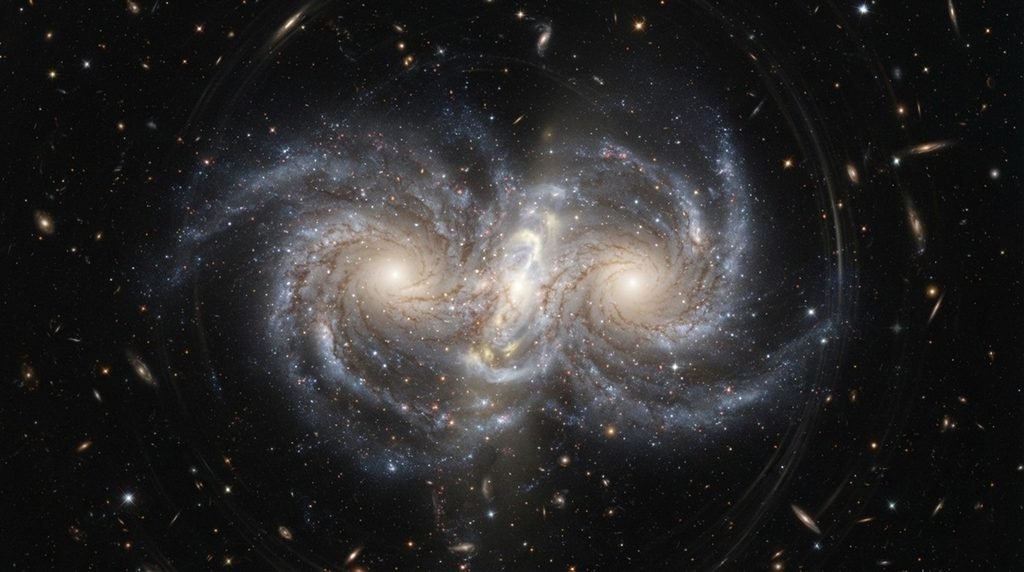
💥 Two colossal groups of galaxies are careening toward each other in a head-on cosmic smashup that challenges everything we know about how the universe builds itself.
Astronomers just caught a spectacular cosmic collision between two massive galaxy clusters that reveals how the universe assembles its largest structures. Deep space observations show giant groupings of thousands of galaxies slamming together in a chaotic dance of superheated gas and dark matter.
This cosmic event allows scientists to map out the invisible scaffolding of our universe while witnessing nature’s ultimate demolition derby. By tracking the ripples left behind by these colossal impacts, researchers can decode how cosmic structures grow, evolve, and spread vast magnetic fields across billions of light-years.
🌌 The Chaos of Cosmic Assemblage
- Traditional astronomical models fail to explain how individual galaxy clusters grow into sprawling cosmic webs without crushing their internal components.
- Telescopes struggle to capture these events because normal optical light cannot pierce through the ultra-thin, invisible gas clouds filling deep space.
- Standard calculations often overlook the complex behavior of cosmic magnetic fields that warp and twist during these giant celestial mergers.
- Scientists have only a single, static snapshot of these collisions, making it incredibly difficult to reconstruct a timeline of the impact.
🛰️ Peering Through the X-Ray Window
- An international team of researchers led by astronomer K. HyeongHan deployed two of the world’s most powerful orbiting space telescopes to solve this cosmic puzzle.
- The team leveraged deep X-ray data from the European Space Agency’s XMM-Newton satellite to map out the glowing, superheated gas clouds.
- High-resolution imaging from NASA’s Chandra X-ray Observations pinned down the exact boundaries where the moving galaxy clusters smash together.
- By focusing on two famous cosmic smashups named MACS J1752.0+4440 and ZwCl 1856.8+6616, the scientists successfully traced the shockwaves of the mergers.
💥 Rewriting the Rules of Galactic Evolution
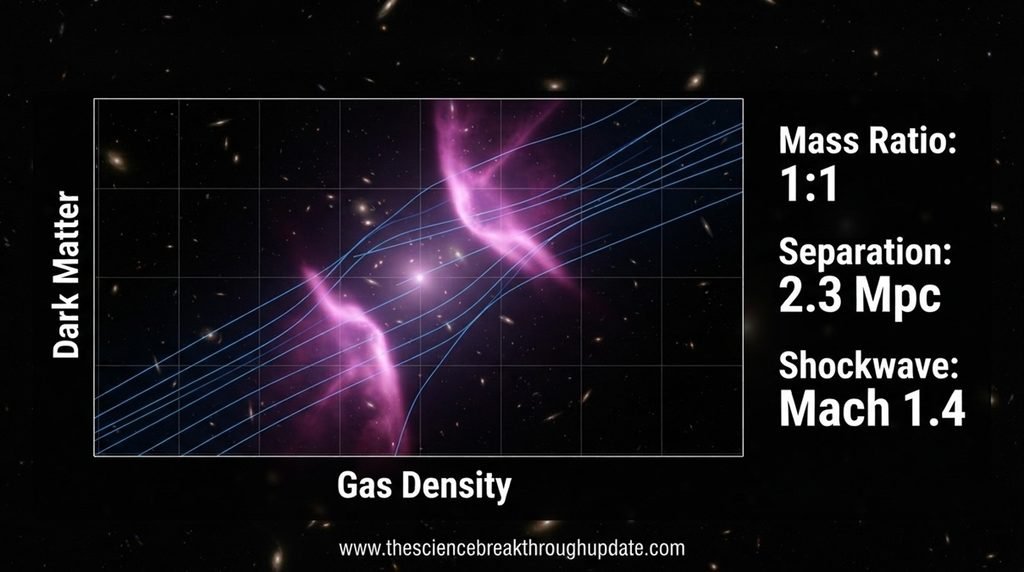
- The sharp X-ray data proved that both cosmic systems underwent nearly 1:1 major mergers, meaning equal-sized giants are colliding head-on.
- Observations revealed highly symmetrical double radio relics, which act as massive sonic booms glowing across the outer edges of the clusters.
- The data showed that the normal gas bogs down during impact while the invisible pools of dark matter sail straight through unhindered.
- This historic tracking map gives astrophysicists a perfect laboratory to test how dark matter behaves when subjected to the universe’s most violent forces.
My Take: Watching dark matter cleanly separate from cosmic gas during these giant collisions strips away theoretical guesswork. It hands us a real-world blueprint to finally understand the invisible skeleton shaping our universe.
❓ Reader Doubts: Core Questions Answered
1. What happens when two galaxy clusters collide?
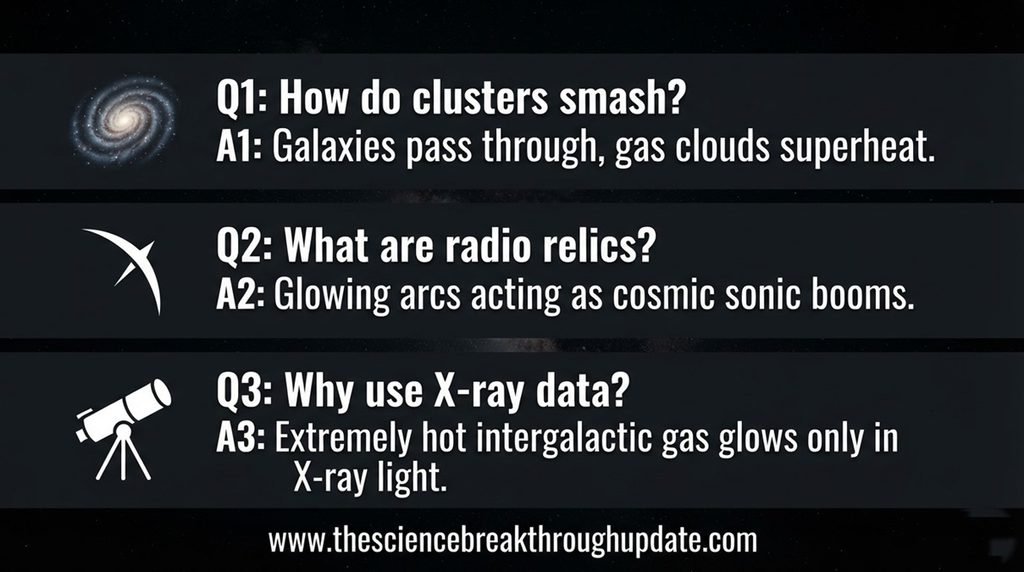
When galaxy clusters collide, the individual stars and galaxies pass right through each other due to the vast distances between them. However, the massive gas clouds between the galaxies smash together, heating up to millions of degrees and releasing intense X-ray radiation.
2. What are the radio relics mentioned by astronomers?
Radio relics are massive, glowing arcs of particle acceleration that form at the outer edges of a merging galaxy cluster. They act like cosmic sonic booms generated by the violent shockwaves of the head-on collision.
3. Why do scientists use X-ray telescopes to study space collisions?
The gas trapped between colliding galaxy clusters is so hot that it only glows in high-energy X-ray light, making it completely invisible to standard optical telescopes. Orbiting observatories like Chandra and XMM-Newton allow scientists to see this otherwise hidden normal matter.
Source Document Link: arXiv.org
Share this useful knowledge with your friends now!”
Disclaimer: This content is based on preliminary scientific research (Preprints) from arXiv.org and current global findings. It is shared strictly for educational and informational purposes and does not constitute professional, legal. Readers are encouraged to verify facts independently and consult relevant experts before making any decisions.