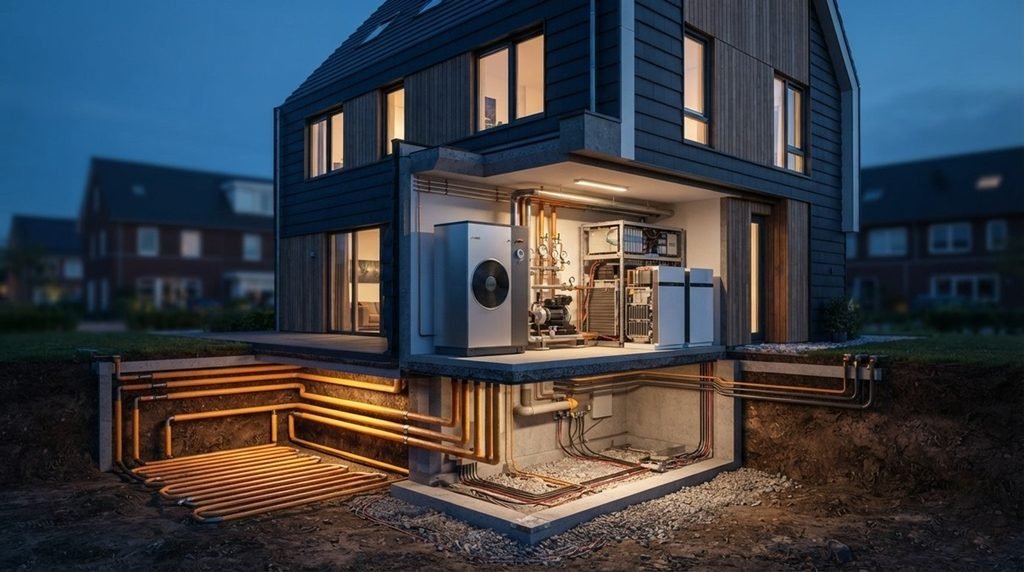
🔥 Imagine a smart system that traps intense summer heat to warm your entire home during freezing winters.
Operating modern residential energy hubs efficiently remains difficult due to massive variations in seasonal weather. Traditional smart home automation setups suffer from severe short-sightedness, completely draining low-efficiency thermal energy storage systems within 48 hours instead of saving heat for freezing winter spells.
To solve this, engineering scientists at the Delft University of Technology developed an innovative data-driven framework in Advances in Applied Energy. Their algorithm directly connects daily operations with seasonal energy planning, maximizing comfort while saving homeowners from volatile grid cost spikes.
📉 The Failure of Short-Horizon Energy Controllers
- Multi-carrier residential energy hubs combining electricity, mobility, and heat struggle to coordinate systems because thermal storage devices have very low round-trip efficiencies.
- Conventional economic model predictive control systems utilize short optimization horizons between 1 to 48 hours, causing them to completely deplete long-term thermal reserves prematurely.
- Local homeowners face high financial over-investments and structural asset sizing issues because standard engineering tools cannot accurately calculate the exact sizing of thermal assets.
- Rigidly tracking an offline heating baseline limits the operational flexibility needed to manage sudden short-term weather uncertainty and price volatility in the Netherlands.
⚙️ Steering Daily Heat Flow Through Data Highways
- Lead researcher Darío Slaifstein designed a data-driven seasonal highway that mathematically steers short-horizon daily operations toward infinite-horizon economic optimality without long year simulations.
- The framework combines localized financial parameters like asset capital expenditures to determine that an optimal 700 kWh thermal storage capacity completely eliminates seasonal depletion risks.
- Stochastic planning simulations calculate dynamic terminal sets and terminal value functions to guide the short-sighted controller exactly like virtual road lanes during real-time operations.
- The system integrates a physics-based optimizer to manage continuous battery degradation alongside non-linear coefficient of performance curves for a 4 kWe heat pump.
💰 Slashing Grid Expenses While Protecting Home Batteries
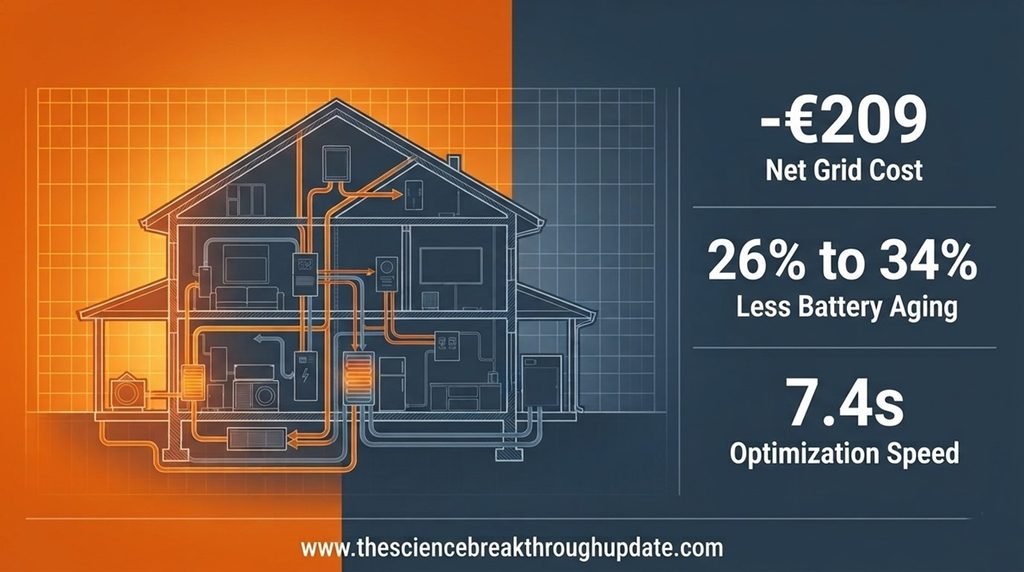
- The seasonally-aware nonlinear policy achieves an outstanding economic performance, securing an optimized negative mean annual grid cost of -€209 for residential building operations.
- Accounting for continuous cell aging dynamics within the nonlinear economic predictive controller reduces expensive battery capacity degradation by 26% to 34% versus linear counterparts.
- The data-driven framework calculates real-time control actions within a mean computational time of just 7.4 seconds per optimization step using high-performance solvers.
- Homeowners achieve reliable long-term thermal self-sufficiency and optimal indoor comfort without facing the risks of unexpected seasonal energy depletion or massive grid bills.
My Take: Splicing seasonal timeframes with daily smart controls finally fixes the biggest flaw in green housing. It proves that clever software, not just massive hardware, will ultimately slash winter power bills.
❓ Reader Doubts: Core Questions Answered
- How does this system preserve summer heat for winter use?
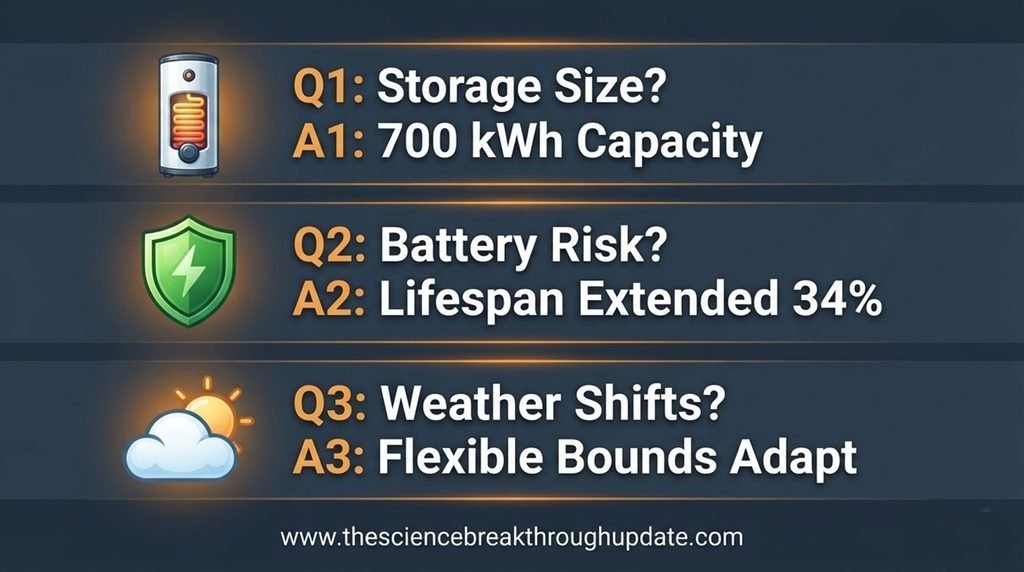
The system determines an optimal 700 kWh thermal storage size using frequency response analysis and financial criteria. The data-driven highway algorithm prevents the short-term controller from wasting this heat early. This effectively locks in mid-summer ambient heat for peak winter heating. - Does this seasonal energy coordination damage home solar batteries?
No, it significantly extends battery lifespan compared to standard linear alternatives. By integrating physics-based battery aging models directly into the optimization constraints, it reduces capacity loss by 26% to 34%. This protects the 15.6 kWh home battery system from severe degradation. - Can the automated controller handle unexpected weather changes?
Yes, the dynamic terminal sets provide flexible operational bounds rather than rigid tracking references. This allows the real-time controller to adapt immediately to sudden short-term weather volatility. Homeowners maintain absolute comfort even during unpredictable climate anomalies
Source Link: arXiv.org
Share this useful knowledge with your friends now!”
Disclaimer: This content is based on preliminary scientific research (Preprints) from arXiv.org and current global findings. It is shared strictly for educational and informational purposes and does not constitute professional, legal. Readers are encouraged to verify facts independently and consult relevant experts before making any decisions.