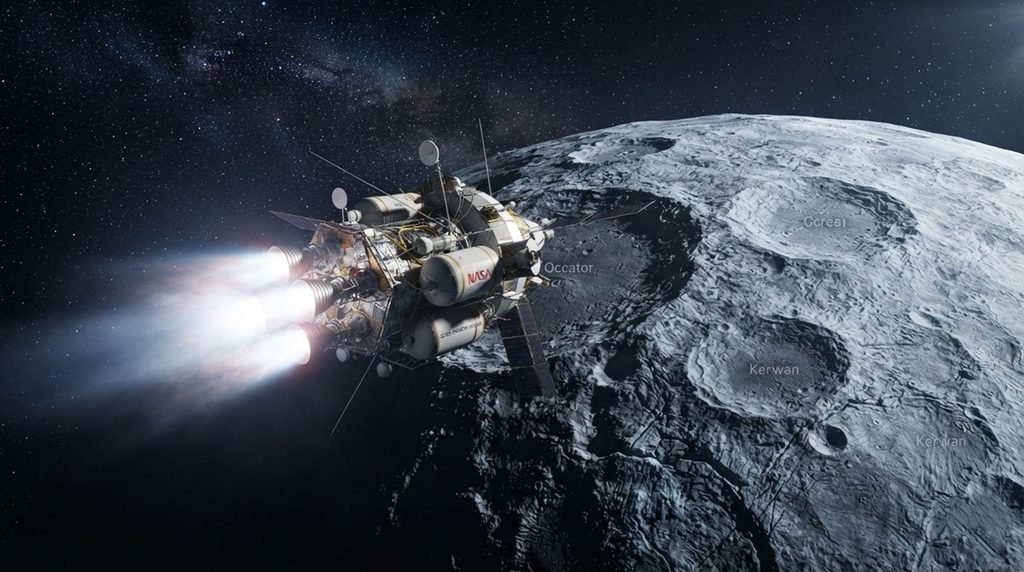
🚀 Humankind might finally escape Earth’s gravity trap by converting a distant, frozen dwarf planet into the ultimate nuclear-powered cosmic refueling station.
For more than 60 years, every single deep-space mission remained completely architecturally self-contained. Spacecraft carried all necessary transportation systems directly from Earth. This traditional approach severely limits exploration because launching massive propellant supplies from the ground creates an incredibly heavy burden.
Now, scientists S. P. Worden and F. G. Kennedy propose a permanent logistics network centered on the dwarf planet Ceres. This new architecture utilizes advanced nuclear thermal propulsion alongside local resources to replace isolated expeditions with a continuous, sustainable timetable.
🛑 The Severe Financial and Mass Constraints of Direct Deep-Space Flights
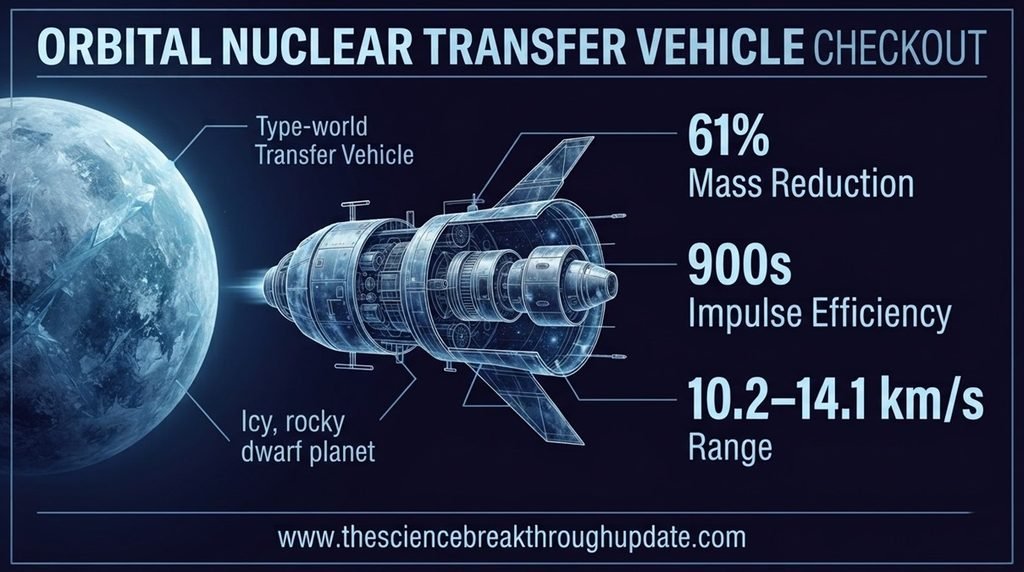
- Direct ballistic transit paths to the main asteroid belt require immense velocity changes ranging between 10.2 and 14.1 kilometers per second.
- Launching all return propellant directly from Earth’s deep gravity well completely prevents the development of reusable space vehicles for long-term logistics.
- Conventional single-stage chemical rockets deliver zero payload mass when the required velocity change across deep space reaches 12.0 kilometers per second.
- Relying completely on independent, self-contained expeditions severely limits the frequency and overall scale of scientific sample return missions beyond Mars.
🛠️ Transforming Ceres Into a Reusable Planetary Refueling Node
- Project CERES establishes a permanent logistics hub combining advanced nuclear thermal propulsion with local resource harvesting on the dwarf planet.
- Mining the ice-rich surface supplies vital resources to manufacture finished liquid hydrogen, oxygen, water, and ammonia propellants directly at the node.
- The remarkably low surface gravity of Ceres allows a massive 100-tonne tanker vehicle to execute easy orbital docking maneuvers instead of dangerous landings.
- Implementing high-thrust engines with 900 seconds of specific impulse performance successfully closes the complex vehicle mass equations for round-trip sorties.
🌌 Establishing a High-Speed Timetable Across the Outer Solar System
- Refueling transport vehicles at the Ceres node slashes the initial launch mass required in low Earth orbit by 61 percent.
- This unique architecture seamlessly links Earth, Mars, and the outer solar system into a unified network operating on a permanent timetable.
- Utilizing locally produced hydrogen allows refueled spacecraft to reach Jupiter and Saturn within highly accelerated, career-inside flight timelines.
- Establishing an abundant water repository provides the foundational infrastructure required to support sustained human presence far beyond the inner planets.
My Take: Mining cosmic ice with nuclear engines finally shifts space travel from wasteful expeditions into an affordable, permanent transport loop. It realistically opens the outer solar system for business.
❓ Reader Doubts: Core Questions Answered
- Why is Ceres chosen as the primary logistics hub instead of Mars?
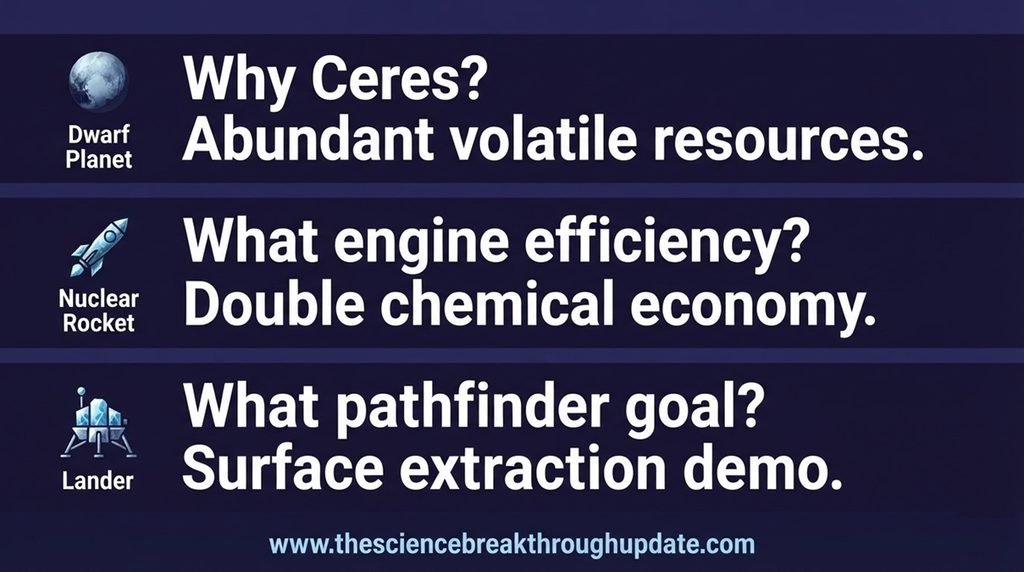
Ceres combines abundant volatile resources like water ice with an exceptionally shallow gravity well that makes landing operations remarkably easy. It sits strategically in the Main Belt, two-thirds of the way out of the Sun’s gravity well. This positioning drastically reduces the total velocity excess required for onward travel to distant outer planets. - How does solid-core nuclear thermal propulsion differ from standard electric thrusters?
Nuclear thermal propulsion pairs high chemical-class thrust with twice the fuel economy of standard chemical rockets. It utilizes a solid-core nuclear fission reactor to heat pure hydrogen propellant to extreme material temperatures approaching 3,000 Kelvin. Conversely, standard electric propulsion systems provide incredibly low thrust levels that extend transit times over multiple years. - What is the primary objective of the initial Project CERES Pathfinder mission?
The Pathfinder mission deploys a single integrated vehicle to perform a comprehensive orbital survey and a small-scale surface extraction demonstration. The spacecraft will safely return the first physical samples from the dwarf planet back to cislunar space within 5 years. This historic flight successfully proves that a spacecraft can replenish its own fuel tanks at a distant world.
Source Document Link: arXiv.org
Share this useful knowledge with your friends now!”
Disclaimer: This content is based on preliminary scientific research (Preprints) from arXiv.org and current global findings. It is shared strictly for educational and informational purposes and does not constitute professional, legal. Readers are encouraged to verify facts independently and consult relevant experts before making any decisions.