
🚨 The massive green energy transition relies on giant utility batteries, but hidden calculation errors might leave cities completely in the dark.
Modern microgrid planning heavily relies on simplified computer models to track how large scale battery systems lose power capacity over time. However, these mathematical shortcuts introduce severe modeling blind spots that threaten long term grid reliability and green infrastructure investments.
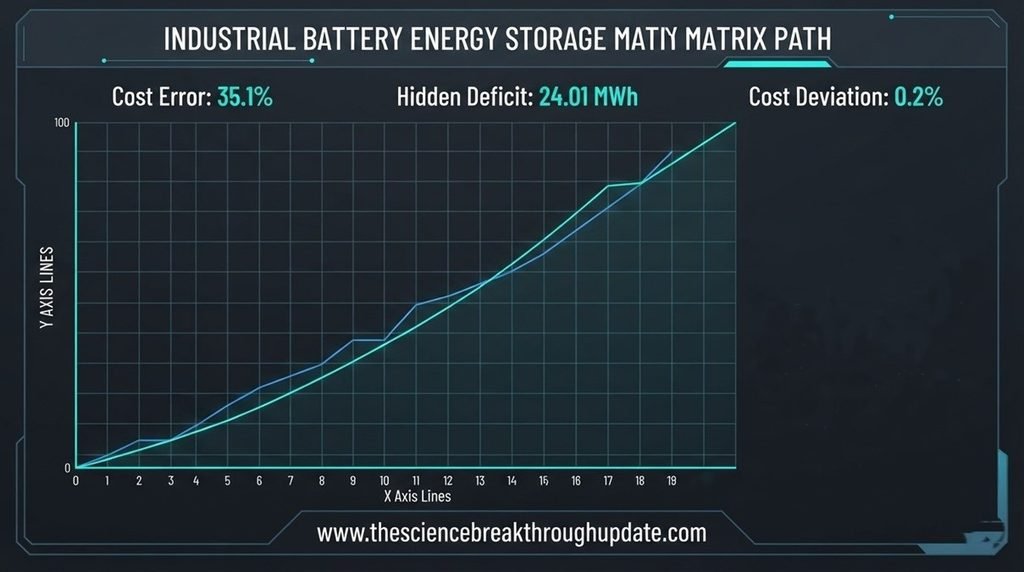
New engineering research from the University of Houston reveals that omitting basic battery aging factors distorts lifecycle predictions. Their core analysis proves that ignoring passive decay factors understates lifecycle net present costs by exactly 35.1% during grid planning.
⚠️ The Dangerous Omissions Hiding Within Grid Models
- Traditional grid planning models completely omit nonlinear calendar aging, assuming commercial microgrid batteries only degrade when actively transferring electrical power.
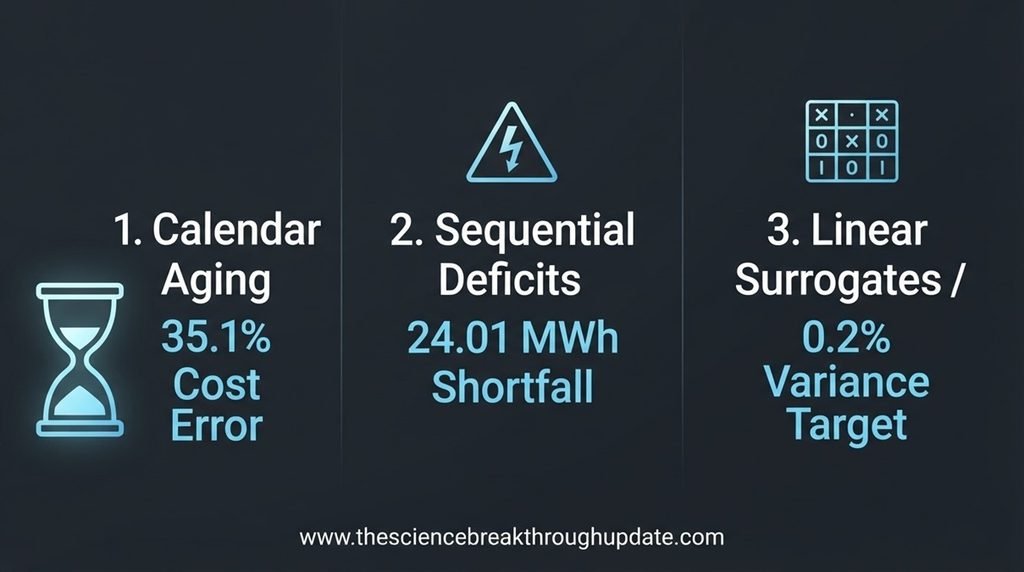
- Skipping this passive degradation mechanism understates the true lifecycle net present cost by 35.1% over a 20 year horizon.
- Standard simulations use reduced chronological profiles that fail to capture severe cumulative energy adequacy shortfalls during sustained daily deficits.
- These flawed engineering calculations hide up to 24.01 MWh of unserved load, falsely claiming perfect long term grid reliability.
⚙️ Calibrating Accurate Mathematical Frameworks for Battery Storage
- University of Houston researchers Hassan Zahid Butt and Xingpeng Li developed a high fidelity validation framework for battery storage systems.
- Their model tracks C rate dependent efficiencies and state of health performance drops using a full 8,760 hour operational chronology.
- The engineering team successfully calibrated a linear surrogate model that limits lifecycle net present cost deviations to a 0.2% total variance.
- This mathematical breakthrough preserves exact battery replacement timing in years 9 and 18 across the 20 year planning horizon.
🛡️ Protecting Critical Multi Million Dollar Energy Infrastructure Assets
- Commercial power operators can now accurately predict battery replacement schedules, protecting multi million dollar grid capital investments from unexpected failures.
- Grid engineers can easily prevent unexpected blackouts by maintaining strict inter day state of charge continuity across rolling operational periods.
- This verified modeling framework ensures energy adequacy metrics remain accurate, preventing catastrophic power shortfalls in localized grid scale infrastructure.
- Long term green infrastructure deployment becomes safely metric dependent, allowing engineers to preserve exact financial and reliability outcomes for communities.
My Take: This study is a harsh reality check for green grids. We cannot build a reliable clean energy future on lazy math that ignores how batteries actually rot over time.
❔ Reader Doubts: Core Questions Answered
- How does calendar aging impact utility scale battery planning?
Batteries lose energy capacity naturally over time even when sitting completely idle. Leaving this factor out of grid models miscalculates degradation timelines entirely. This error causes utility operators to miss 2 crucial equipment replacement cycles. - Why do simplified representative day models fail to predict grid blackouts?
Simplified models often focus on isolated peak hours instead of sustained daily energy deficits. This method fails because it disrupts chronological state continuity surrounding critical grid stress events. Consequently, systems run out of power unexpectedly. - How does the new linear surrogate model improve grid optimization?
The calibrated linear surrogate model captures both calendar and throughput cycling constraints simultaneously. It matches the reference model’s replacement years while keeping total cost errors down to 0.2%. This allows fast simulations without sacrificing accuracy.
Source Document Link: arXiv.org
Share this useful knowledge with your friends now!”
Disclaimer: This content is based on preliminary scientific research (Preprints) from arXiv.org and current global findings. It is shared strictly for educational and informational purposes and does not constitute professional, legal. Readers are encouraged to verify facts independently and consult relevant experts before making any decisions.