🤫 Imagine walking into a chaotic, deafening room and magically tuning out every single voice except the one person you are looking at.
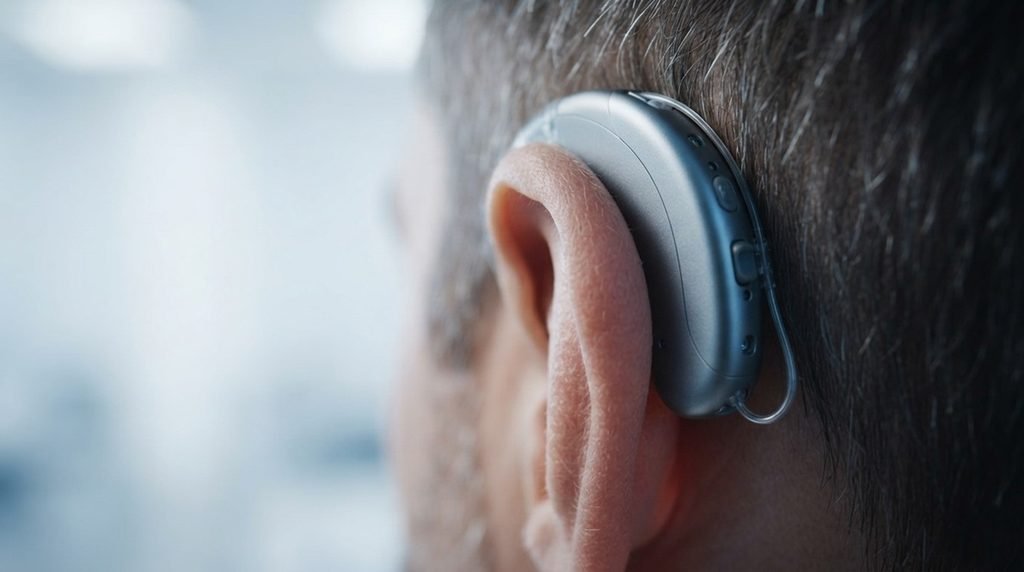
For decades, the human brain has effortlessly solved the infamous cocktail party problem by isolating specific voices in loud rooms. Yet, modern hearing aids constantly struggle in noisy environments because they cannot truly read a user’s true biological focus in real-time.
Now, a major breakthrough from The Ohio State University changes everything by tracking natural human behaviors like eye gaze and head movements. This multi-sensor approach finally allows smart devices to decode auditory attention with remarkable accuracy under realistic, everyday listening conditions.

🔊 The Frustrating Failure of Modern Hearing Assistive Devices
- Conventional hearing aids perform poorly in noisy rooms because they rely solely on broad directional microphones instead of tracking individual human attention.
- Previous auditory research locked participants in silent rooms and forced them to stare at a rigid central crosshair without blinking.
- Restricting natural body movement ignores how humans actually listen, as we constantly move our eyes and shift our heads toward a chosen speaker.
- Relying exclusively on complex brainwave data creates a massive data deficit that leaves modern decoders guessing which competing voice really matters.
🧠 How Multi-Sensory Fusion Finally Cracks the Auditory Code
- A team led by K M Naimul Hassan and Ali Alavi built the MAESTRO corpus, a multi-modal dataset tracking unconstrained human behavior.
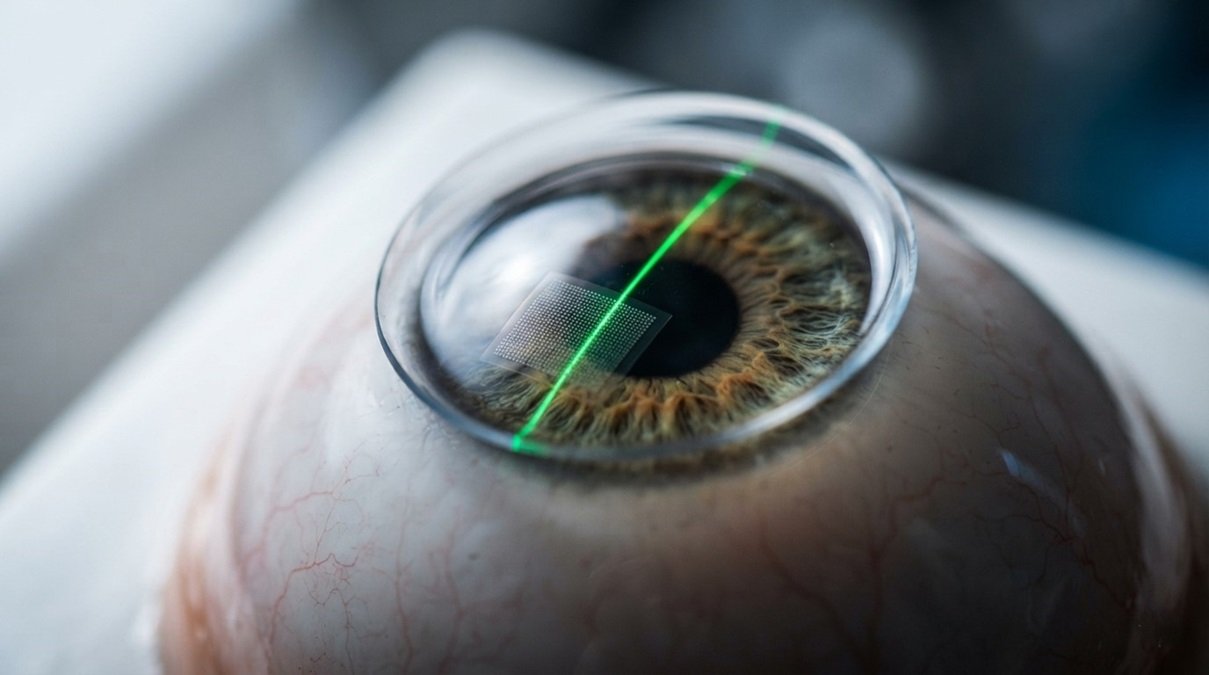
- The system utilizes specialized eye-tracking glasses to capture binocular gaze coordinates and pupillometry while recording environment audio.
- Integrated head inertial measurement units record real-time motion while a 32-channel EEG headset tracks continuous neural activity.
- Combining these physical behavioral signals with neural data provides a complete multi-encoder convolutional network that maps attention flawlessly.
🚀 The Massive Impact on Wearable Tech and Future Hearing Aids
- Integrating natural behavioral signals alongside brainwaves yields a massive 13% accuracy boost over traditional, highly restrictive EEG-only models.
- The multi-sensor fusion model thrives during ultra-short 5-second decision windows, allowing smart devices to react instantly as conversations shift.
- This dataset proves that simple body movements act as a powerful complement to neural tracking, rather than a distraction.
- These findings pave the way for intelligent, neuro-steered hearing aids that seamlessly amplify the exact speaker you choose to face.
My Take: Hearing aids have ignored how we actually move and look for way too long. By blending gaze with brainwaves, this tech finally makes seamless everyday audio tracking a reality.
❓ Reader Doubts: Core Questions Answered
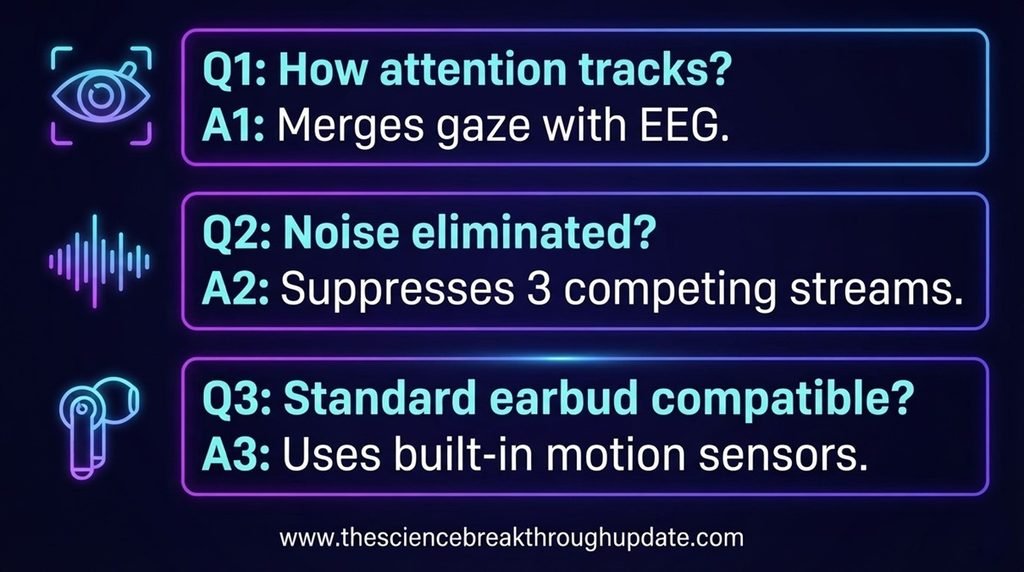
- How does this technology know which voice I want to hear?
The system tracks your natural physical behaviors alongside your brainwaves. By combining your eye gaze direction, head orientation, and neural responses, it accurately isolates the speaker you are focusing on. - Will this eliminate background noise in public spaces?
Yes. By using multi-sensor fusion, future devices can selectively amplify the target voice while actively suppressing competing background noise and other surrounding speakers. - Can this system work with standard smart earbuds?
Modern consumer earbuds already contain motion sensors and microphones. Integrating these components with compact eye-tracking technology will allow developers to build highly responsive, intelligent hearing assistance tools.
Source Document Link: arXiv.org
Share this useful knowledge with your friends now!”
Disclaimer: This content is based on preliminary scientific research (Preprints) from arXiv.org and current global findings. It is shared strictly for educational and informational purposes and does not constitute professional, legal. Readers are encouraged to verify facts independently and consult relevant experts before making any decisions.