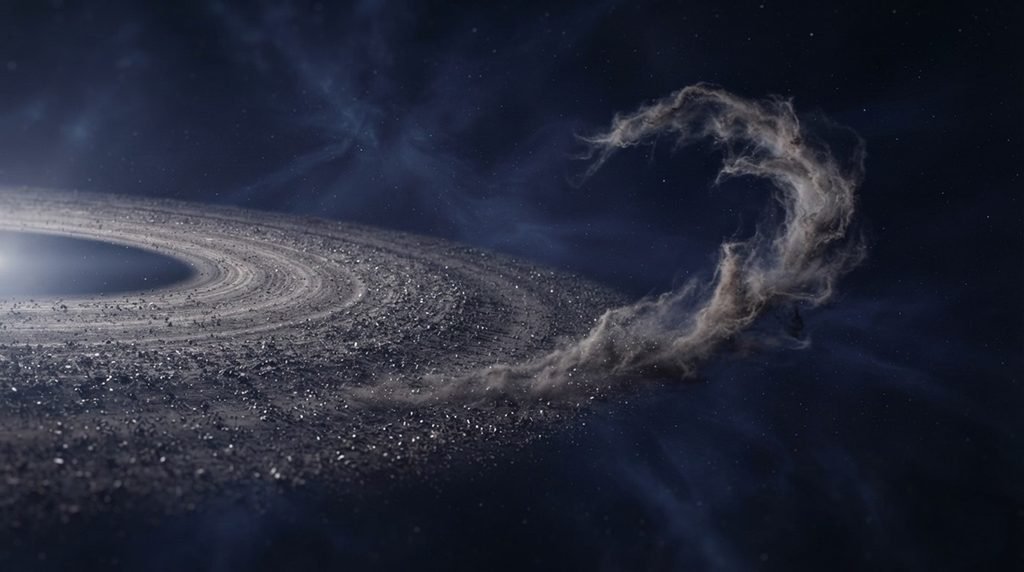
Something is flashing in the deep cosmos 63 light-years away, and it is a massive, curling cosmic trail shaped exactly like a giant cat’s tail.
🚀 Astronomers just pulled back the curtain on one of the most baffling cosmic structures ever detected by combining archival and new observations spanning multiple epochs. This glowing interstellar dust tail stretches deep into space within the Beta Pictoris system, raising massive questions about what triggers such chaotic structural formations.
🌌 This completely flips our understanding of how young planetary systems mature over millions of years. Instead of clean, circular planetary paths, this chaotic system proves that catastrophic collisions are constantly reshaping stellar architecture across the universe, altering galactic evolution permanently.
The Chaos Hidden Inside Young Beta Pictoris
- ☄️ The young nearby star system Beta Pictoris hosts a massive, unstable debris disk of swirling dust and rocky material.
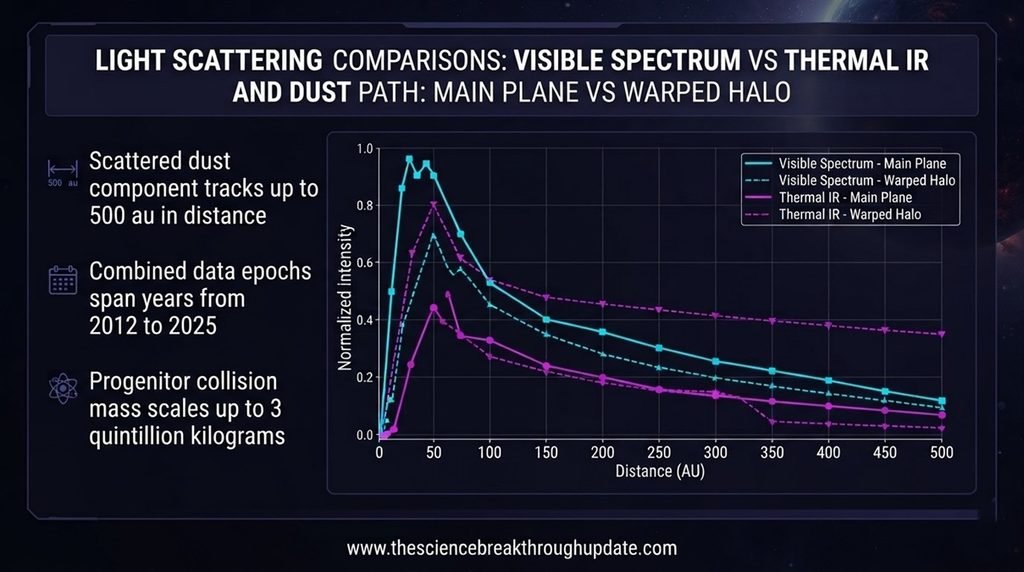
- 🌫️ Advanced coronagraphic imaging achieves a signal-to-noise ratio over 100 across much of the system’s central midplane.
- 🌀 Deep observation detects the visible and near-infrared scattered light component of the main midplane out to 500 astronomical units.
- 🌌 Traditional space models failed to predict how light reflects off this newly mapped scattered light component.
How Two Deep Space Dwarfs Shattered Together
- 🪐 Two massive, ice-rich dwarf planets collided at hyper-velocity speeds within the inner stellar ring.
- 🧲 Each colliding progenitor must have a mass of at least 1 to 3 quintillion kilograms to fuel the system.
- 💥 The violent pulverization released trillions of tons of porous organic refractory material into empty space.
- ✨ This specific dust reflects a total flux of only 0.1% to 0.4% compared to thermal infrared measurements.
Why This Dust Trail Rewrites Planetary Evolution
- 📊 Astronomers must now recalculate the actual frequency of giant planetary impacts in youthful systems.
- ⚙️ The high volume of organic carbon proves that prebiotic building blocks survive highly violent cosmic impacts.
- 🔭 Scientists can now track erratic planet migrations by observing the warped halo morphology of external disks.
- 🚀 The discovery completely changes how we map the structural history of evolving extrasolar architectures worldwide.
My Take: Seeing a massive structural scar shaped like a cat’s tail proves that space is beautiful yet deeply violent. Our calm solar system is a rare, lucky exception.
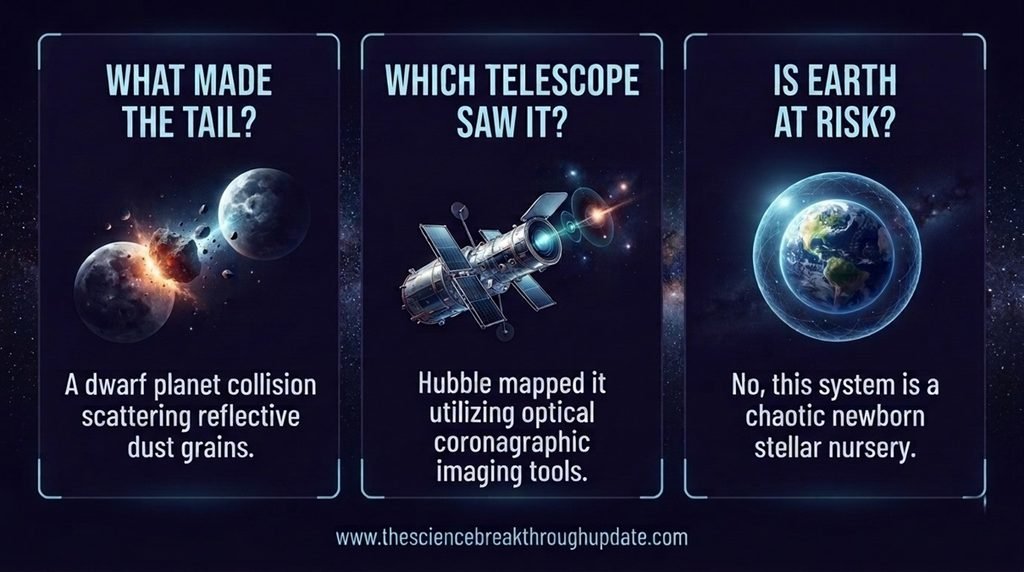
Reader Doubts: Core Questions Answered
- What created the giant space cat’s tail?
- 🌟 A massive collision between two icy dwarf planets pulverized rock and ice, releasing trillions of tons of reflective dust. Radiation pressure and stellar forces then pushed this debris outward into a sharp, curling tail structure.
- Which telescope caught this new discovery?
- 🌌 The Hubble Space Telescope mapped the structure using advanced optical coronagraphic imaging to filter out blinding starlight. This followed initial infrared observations made earlier by the James Webb Space Telescope.
- Is our solar system at risk of a similar crash?
- 🛑 No, our home solar system is highly mature and stable, with planets locked into cleared, predictable orbits. This type of chaotic, planet-shattering wreckage only happens in newborn star systems full of untamed debris.
Source Document Link: arXiv.org
Share this useful knowledge with your friends now!”
Disclaimer: This content is based on preliminary scientific research (Preprints) from arXiv.org and current global findings. It is shared strictly for educational and informational purposes and does not constitute professional, legal. Readers are encouraged to verify facts independently and consult relevant experts before making any decisions.