🩺 Your home pulse oximeter might be giving you dangerously false readings based entirely on the color of your skin.
🚨 Standard medical sensors frequently fail people of color because light behaves differently when passing through darker skin tones. This systemic flaw hidden inside everyday pulse oximeters causes critical delays in receiving oxygen therapy during respiratory emergencies. Medical bias in hardware design means darker pigments absorb extra light, which routinely tricks sensors into reporting healthy numbers even when blood oxygen levels drop.
💡 A group of visionary researchers has finally engineered a brilliant computational approach that eliminates this dangerous flaw without altering physical hardware. Medical scientists Giles Blaney, Jodee Frias, Ravi Durbha, Sergio Fantini, and Valencia Koomson created a new correction model that isolates and removes optical interference from the light signal. This modern update calibrates the pulse oximeter dynamically by measuring the specific light scattering properties of the user’s skin layers.
The Hidden Target That Confuses Modern Medical Sensors
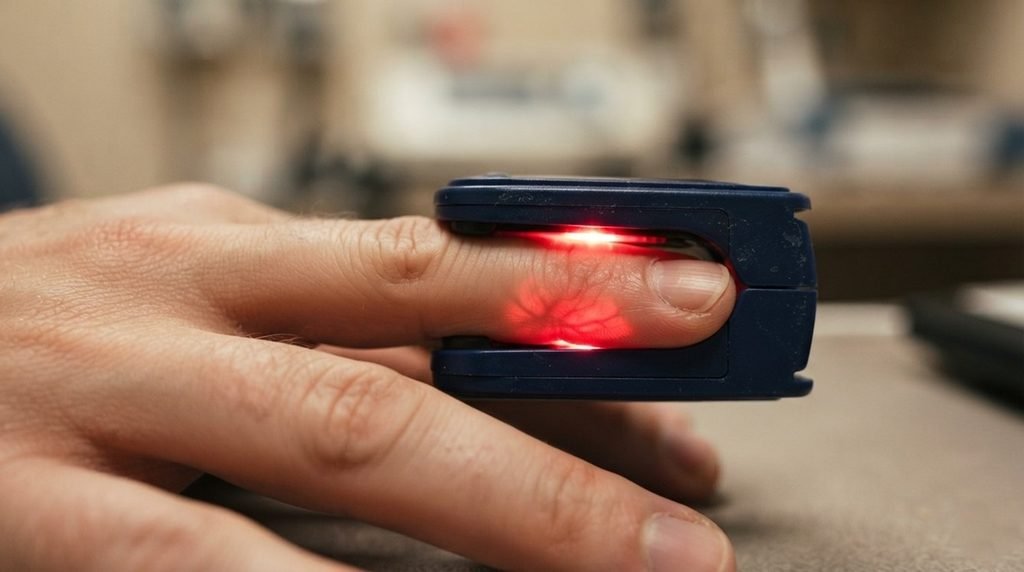
- 🛑 Standard pulse oximeters send red and infrared light through the finger to calculate how much oxygen your blood cells carry.
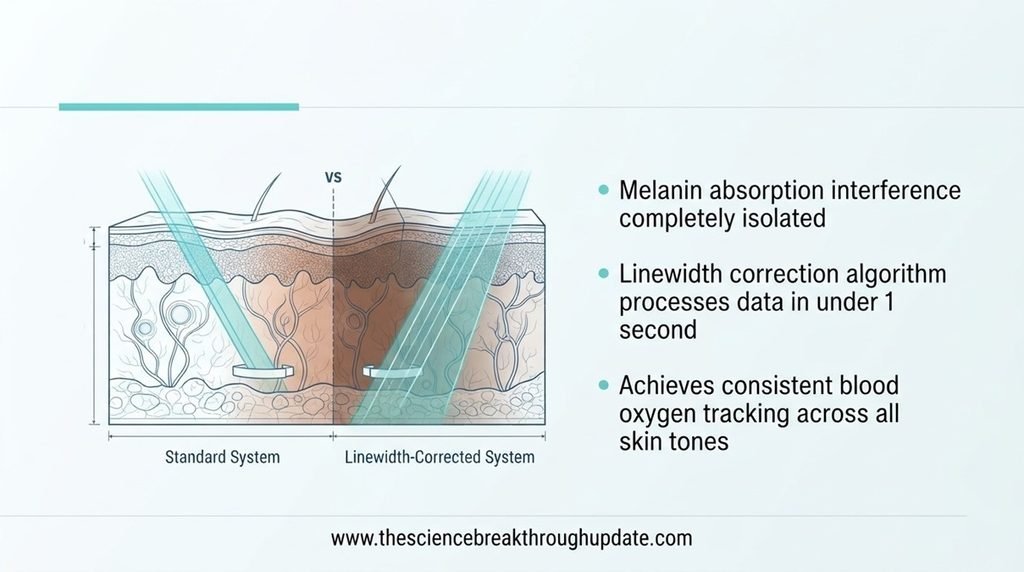
- 🧬 Melanin pigments in darker skin naturally absorb these specific light wavelengths, which disrupts the delicate calibration of standard retail sensors.
- ⚠️ This optical interference forces the machine to overestimate actual oxygen levels, creating a false sense of safety during health crises.
- 📉 Doctors call this phenomenon occult hypoxemia, where a patient suffers from severe oxygen deprivation that the standard monitor completely misses.
How Scientists Rebuilt the Math Behind the Light
- 🔬 The research team introduced a melanin- and linewidth-corrected pulse-oximetry method that separates blood absorption metrics from skin surface pigmentation values.
- 🧮 This mathematical model measures how light spreads sideways through skin tissues to calculate exact personal melanin density levels.
- ⚡ The sensor then subtracts the calculated skin interference from the raw data stream in less than 1 second.
- 🎯 This digital correction ensures that the final reading reflects actual arterial blood composition rather than surface skin color.
What This Means for Daily Healthcare and Patient Safety
- 🏥 Hospital emergency rooms can immediately deploy this software update to eliminate racial disparities in triage and respiratory care.
- 🏠 Home health monitors will become reliable lifelines for millions of minority patients managing chronic conditions like asthma or COPD.
- 💰 This upgrade prevents unnecessary hospitalizations by providing accurate data, which saves families thousands of dollars in medical bills.
- 🌍 Fixing this flaw sets a new global benchmark for developing inclusive medical technology that protects everyone equally.
My Take: This elegant software update fixes a deadly racial bias in medical hardware without requiring expensive physical redesigns, offering a quick, practical path to equitable healthcare for millions.
Reader Doubts: Core Questions Answered
1. Why do normal pulse oximeters struggle with dark skin?
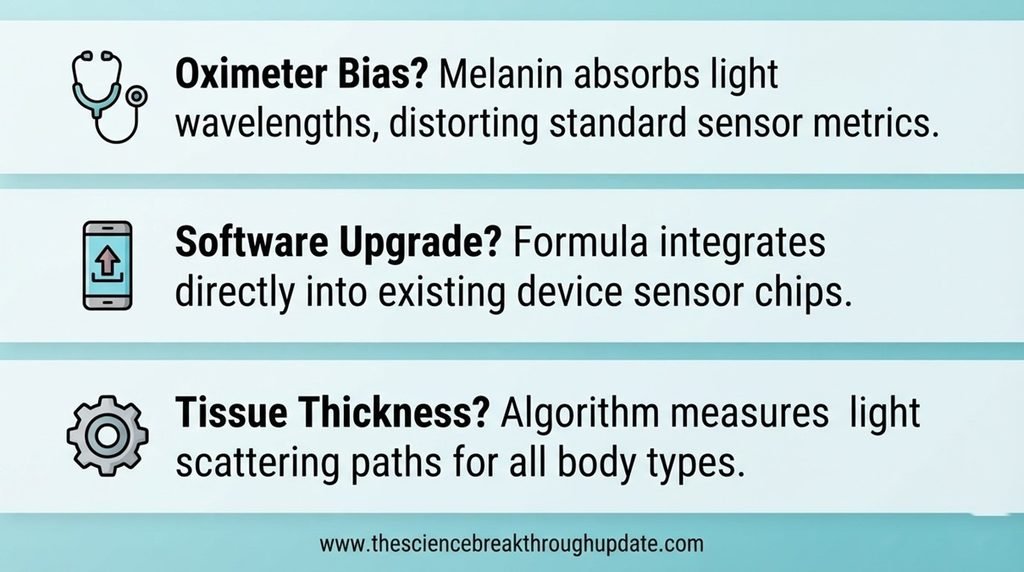
👉 Standard monitors assume light only interacts with blood cells. Because melanin absorbs light similarly to oxygenated hemoglobin, it distorts the sensor’s calculations on darker fingers.
2. Can this new correction system work on existing devices?
📲 Yes, this approach works as a digital upgrade. Manufacturers can integrate the mathematical formula directly into the software chips of existing sensor designs.
3. Does skin thickness alter the accuracy of the new system?
⚙️ The new algorithm specifically accounts for both skin thickness and tissue structure. It measures light scattering paths to ensure accuracy regardless of body type.
Source Document Link: arXiv.org
Share this useful knowledge with your friends now!”
Disclaimer: The information on this website is for educational and informational purposes only and is not intended as medical advice. Always consult a qualified healthcare professional before making any medical decisions or changes to your treatment plan.