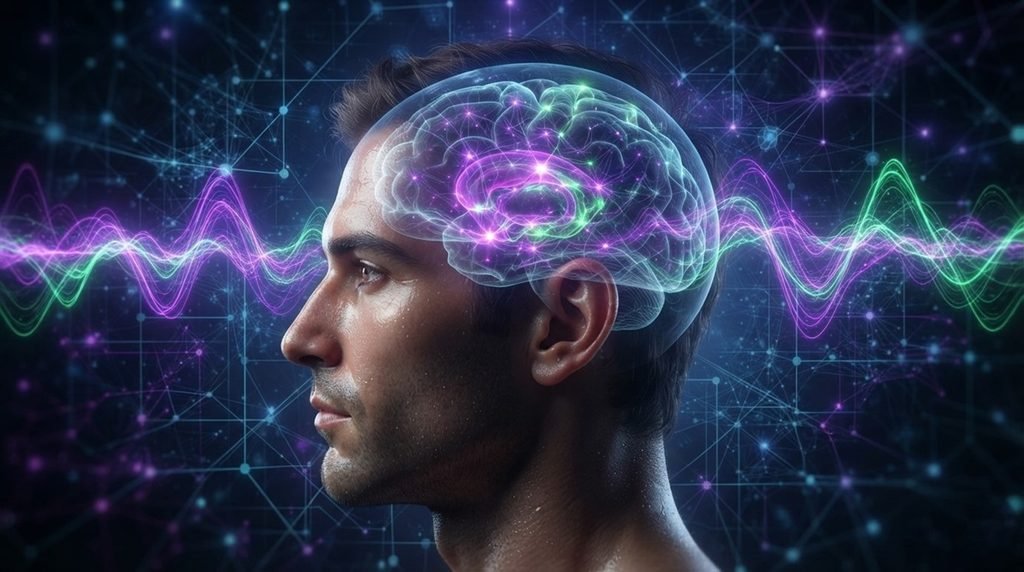
Your chaotic feelings do not just disrupt your thoughts; they create a structured mathematical noise that completely alters human decisions.
🧠 Intense emotional variables act as an unpredictable force inside biological networks. Psychological fluctuations generate complex internal colored noise that traditional behavioral models fail to map accurately. This deep mathematical noise quietly changes how individuals process information and execute vital long-term strategic choices.
📊 A breakthrough study by scientists V.I. Yukalov and E.P. Yukalova published in the journal Biosystems maps how feelings operate as intrinsic colored noise within interactive systems. Their formulas prove that structural memory actively shapes biological decisions by converting random emotional spikes into highly correlated behavioral patterns.
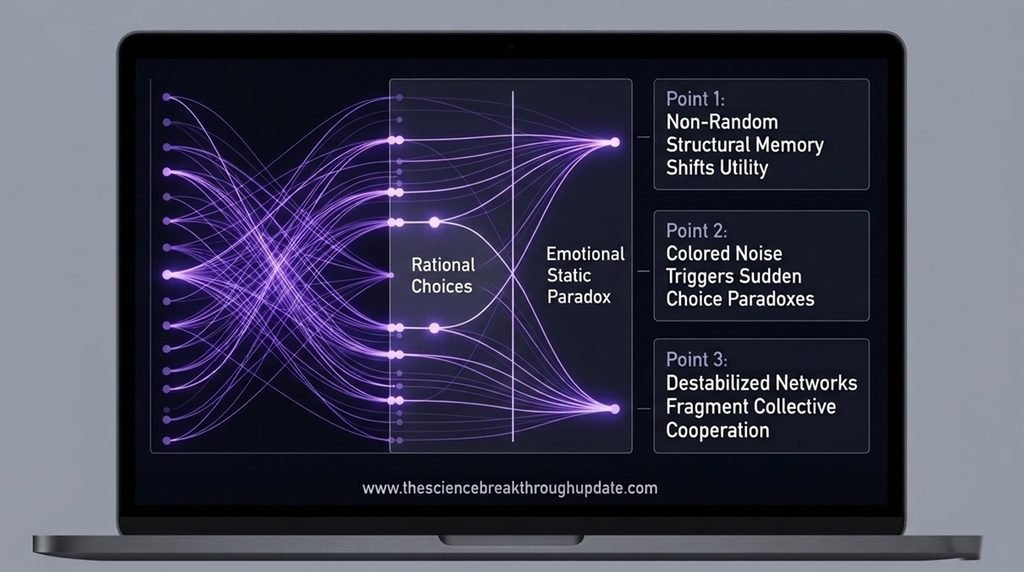
How Emotional Static Triggers Unpredictable Network Decisions
- 🚫 Persistent emotional noise acts as a hidden barrier that completely jams rational information exchange pathways between interactive agents.
- 📉 Chaotic psychological variables disrupt the natural, predictable patterns of choice, causing sudden structural paradoxes during complex cooperative tasks.
- ⚠️ Unregulated emotional frequencies trigger erratic behavior, which rapidly weakens the collective stability of tightly bound social groups.
- ❌ Intrinsic biological noise forces individuals to make irrational shifts, leading to suboptimal group performance during critical decision points.
The Mathematical Breakthrough Mapping Behavioral Memory and Noise
- 📐 The research team successfully applied advanced statistical physics to translate human emotional shifts into precise structural noise equations.
- 🧬 Their specialized equations prove that intense emotions generate a specific frequency known as colored noise in living networks.
- ⏱️ This model tracks how random psychological spikes transition into structured, long-lasting memory effects inside biological systems.
- 🧮 The formula allows behavioral scientists to analyze exactly how internal noise can regulate or destabilize collective actions.
Why Mapping Colored Noise Will Transform Behavioral Analysis
- 🖥️ Strategic technology developers can now design advanced predictive models that detect early structural instability within interactive networks.
- 🔍 Behavioral analysts can utilize these mathematical equations to create highly specialized frameworks that neutralize negative group biases.
- 🤝 Understanding colored noise empowers researchers to use precise network adjustments to restore optimal system cooperation naturally.
- 🌐 This discovery bridges the gap between physics and psychology, paving the way for true mathematical decision tools.
My Take: Proving that mood swings follow distinct physics equations completely alters behavioral science, allowing researchers to use raw mathematics to stabilize real-world political and corporate choices.
### Reader Doubts: Core Questions Answered
- What exactly is colored noise in human behavior?
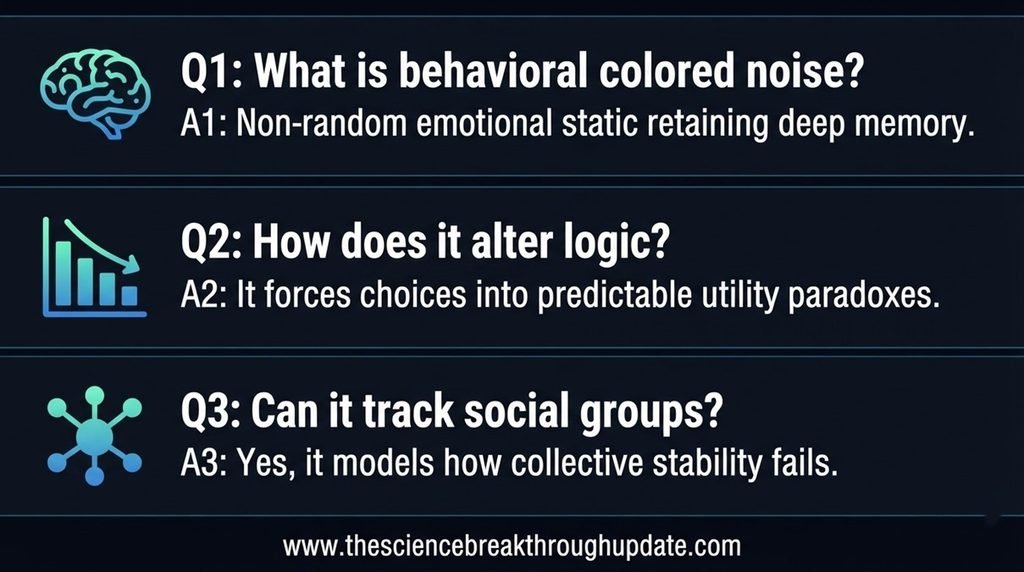
💬 Colored noise refers to structured, non-random internal variations generated by emotional states. Unlike completely random noise, these specific frequencies retain a memory of past states and actively influence how you make decisions. - How do emotions create a paradox in decision-making?
📉 Persistent emotions create a continuous state of internal noise that overrides purely rational logic. This static shifts your choices away from expected utility, causing predictable decision paradoxes that standard economic theories cannot explain. - Can this mathematical model predict group behaviors?
📊 Yes, this model applies statistical physics to track how individual emotional noise spreads through networks. By calculating the interaction of colored noise and memory, it predicts how entire groups stabilize or fail during cooperative tasks.
Source Document Link: arXiv.org
Share this useful knowledge with your friends now!”
Disclaimer: This content is based on preliminary scientific research (Preprints) from arXiv.org and current global findings. It is shared strictly for educational and informational purposes and does not constitute professional, legal. Readers are encouraged to verify facts independently and consult relevant experts before making any decisions.