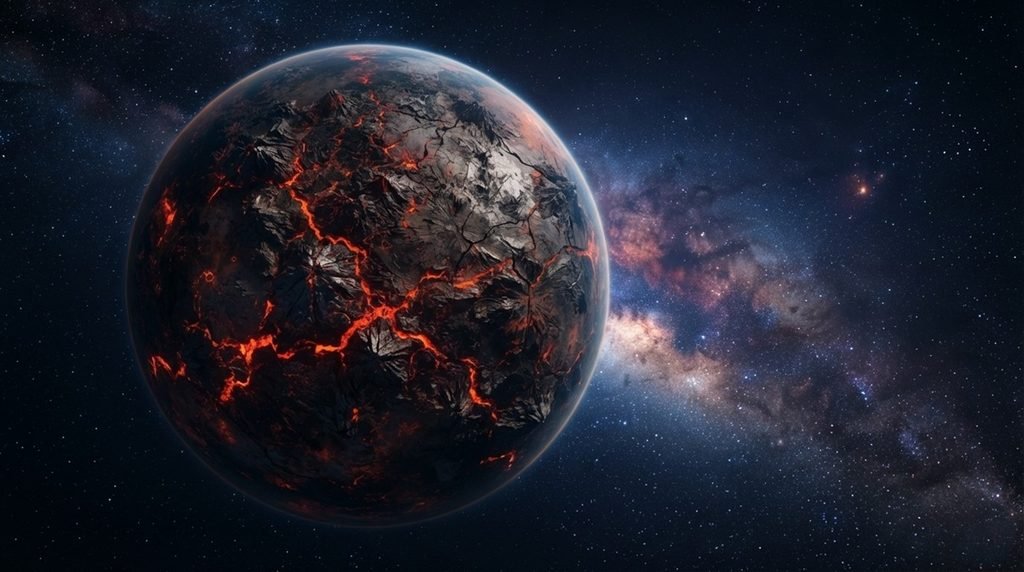
Astronomers have discovered that giant rocky planets orbiting distant stars are physically shrinking in size by up to 10% during their natural cooling cycle, unlocking a massive galactic mystery.
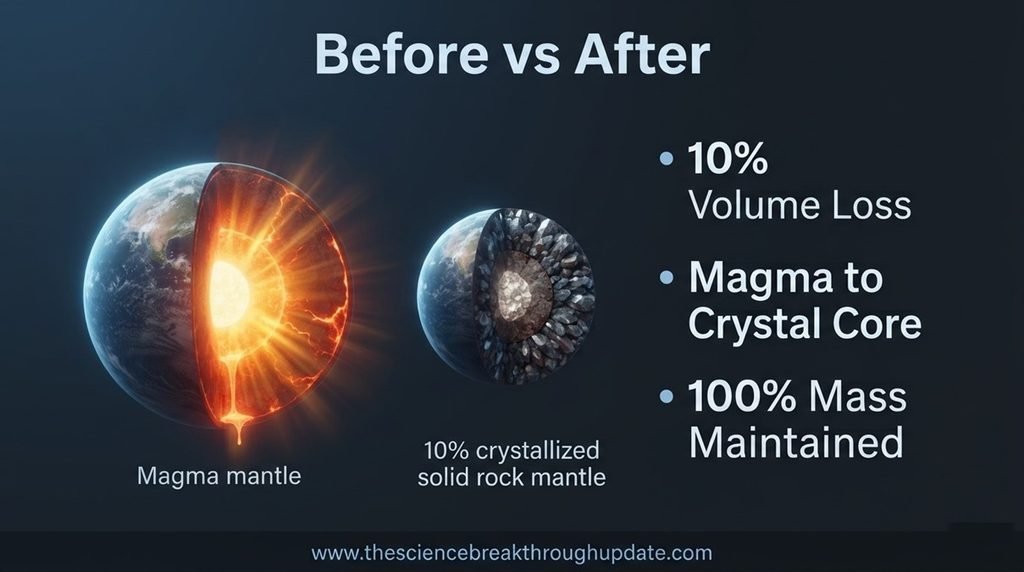
🌋 This structural change occurs deep inside the planet’s core, where liquid magma turns into solid crystal. Scientists must now rewrite how they evaluate alien worlds, as this 10% volume reduction alters everything we know about planet density.
The Hidden Structural Crisis Inside Giant Rocky Worlds
- 🪐 Massive super-Earths look stable from the outside but experience violent structural changes internally as their hot interiors cool over billions of years.
- 🔭 Planet hunting telescopes often struggle to calculate the exact physical density of these distant alien worlds due to unknown internal compression.
- 🌡️ Standard planetary models completely ignored how liquid magma oceans change in volume when they freeze into solid rock under extreme gravitational pressure.
- 🛰️ This missing calculation created massive errors in identifying whether a distant world was a rocky planet or a gas-rich mini-Neptune.
How Rocky Interiors Collapse Under Cosmic Pressure
- 🧑🔬 Astrobiologist Tim Lichtenberg and a global team of researchers simulated how planetary interiors behave during intense thermal cooling phases.
- 💎 The team discovered that the crystallisation of magma forces the entire atomic structure of the planet to pack tightly together.
- 📉 High-pressure physics models proved that this phase transition causes a massive 10% structural shrinkage in the planet’s total volume.
- 🌌 The peer-reviewed research shows that the internal mantle collapse happens naturally without losing any actual planetary mass into open space.
Why This Discovery Changes Our Search for Alien Life
- 🧪 Space agencies can now accurately determine the true chemical composition of distant planets using precise volume and density corrections.
- 👽 The study helps astronomers identify which planets can retain stable atmosphere layers and surface water for potential alien life.
- 🌋 Scientists can better predict the presence of active plate tectonics which require specific interior densities to drive volcanic activity.
- 🎯 Future space telescopes will use these updated metrics to scan the galaxy for habitable rocky worlds with perfect accuracy.
My Take: Finding alien life requires flawless math, and this discovery prevents us from chasing dead ends. By fixing planetary density errors, space agencies can now target truly habitable cosmic real estate.
Reader Doubts: Core Questions Answered
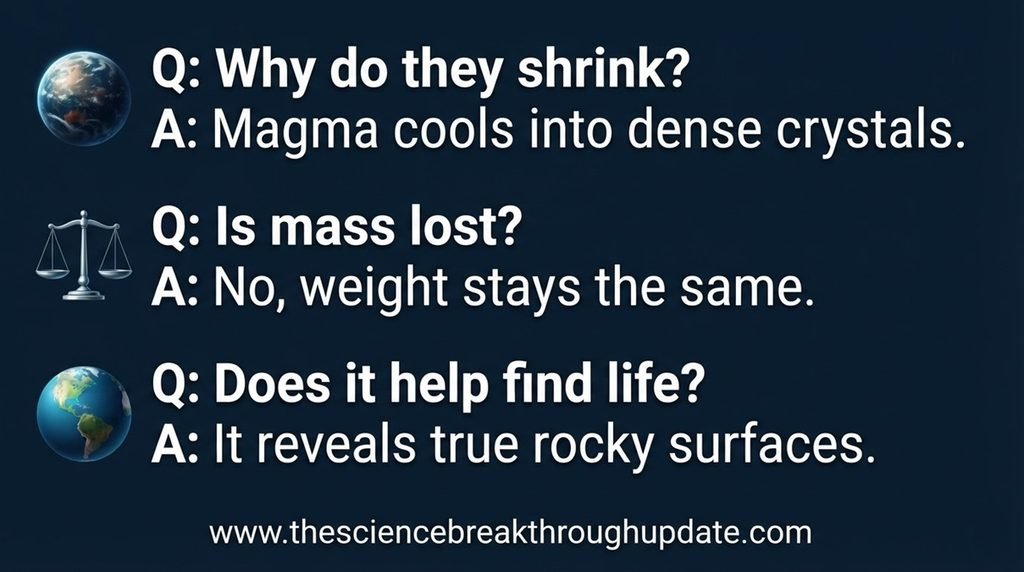
1. Why do super-Earth planets shrink as they get older?
❄️ Super-Earths shrink because their massive internal liquid magma oceans slowly cool down and turn into solid crystals. This freezing process packs the planetary material much tighter together, reducing the planet’s overall volume by up to 10%.
2. Does a planet lose its weight or mass when it shrinks?
⚖️ No, the planet does not lose any weight or actual mass during this process. The exact same amount of planetary material remains, but it compresses into a much tighter, denser package.
3. How does this discovery help find habitable planets?
🌍 Knowing the exact density helps scientists separate true rocky planets from gas-bloated worlds. This allows astronomers to focus their search on planets that have solid ground, stable atmospheres, and liquid water.
Source Document Link: arXiv.org
Share this useful knowledge with your friends now!”
Disclaimer: This content is based on preliminary scientific research (Preprints) from arXiv.org and current global findings. It is shared strictly for educational and informational purposes and does not constitute professional, legal. Readers are encouraged to verify facts independently and consult relevant experts before making any decisions.