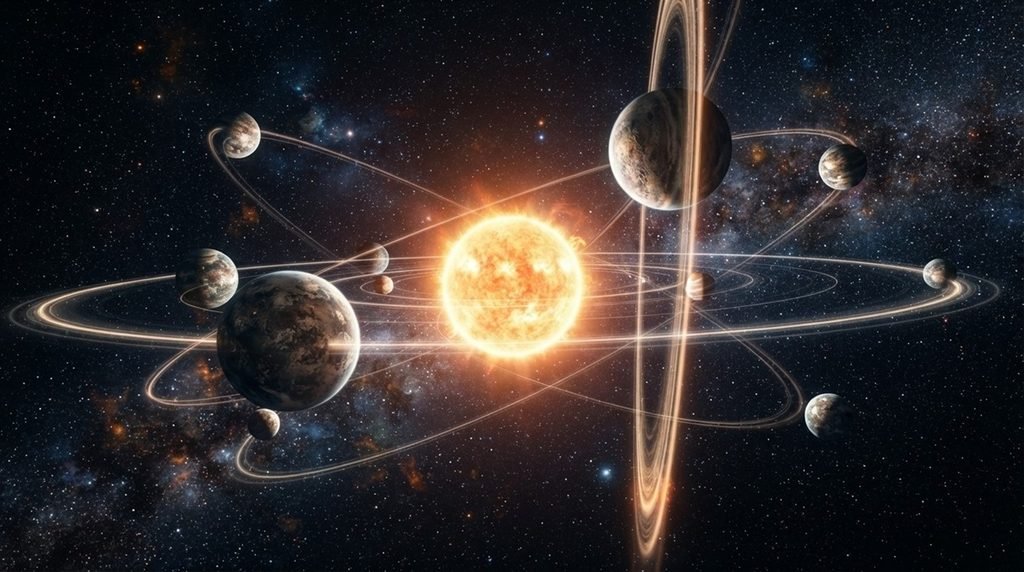
Imagine a cosmic clockwork where planets do not follow the standard flat plane of our own solar system but instead orbit in wildly chaotic, perpendicular directions.
💡 Astronomers studying distant solar systems have uncovered structural properties that redefine space physics. Their observations analyze highly misaligned planetary tracks, mapping systems where multiple worlds cross at extreme angles. By modeling these configurations, researchers unlock how gravitational interactions shape exoplanet architectures across the universe.
🌌 This comprehensive framework breaks the conventional bias of flat planetary formation. The research proves that cosmic layouts can be far more complex than standard models predict. Through the tracking of mismatched orbits, scientists expand the traditional templates used to identify alien worlds globally.
Why Tilted Worlds Keep Breaking the Traditional Rules of Physics
- 🌌 The standard model of space science dictates that planets must form out of a flat, spinning disk of dust and gas around a newborn star.
- 🪐 This uniform rotation ensures that all surrounding worlds orbit within a single, orderly plane, just like the major planets in our solar system.
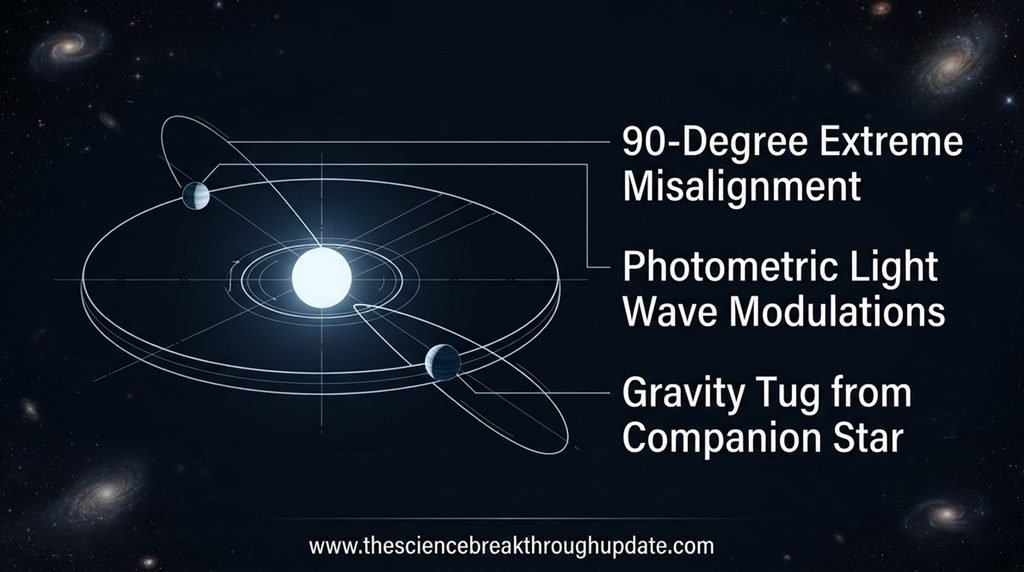
- ☄️ However, newly modeled exoplanets frequently shatter this peaceful layout by traveling along heavily mismatched, crossing orbital paths.
- 🛑 Finding multiple worlds that fly in perpendicular directions presents a massive puzzle because normal gravitational evolution should theoretically damp out extreme cosmic chaos.
The Subtle Light Traces Unlocking the Secrets of Strange Orbits
- 👨🔬 Renowned astrophysicists J. Lillo-Box and O. Balsalobre-Ruza published a comprehensive framework detailing how to map these highly misaligned alien worlds.
- ⚙️ The methodology utilizes high-precision tracking of photometric orbital phase modulations to reveal exoplanet architectures without relying on direct visual imaging.
- 🔬 This observation technique isolates the incredibly tiny variations in reflected starlight as an exoplanet moves through its distinct orbital cycles.
- 📊 The data models prove that subtle variations in light curves can accurately pinpoint severe orbital misalignments caused by hidden planetary or stellar companions.
How This Tilted System Reshapes Our Understanding of the Universe
- 📐 Outlining these radical layouts proves that planetary systems can sustain highly unstable, perpendicular architectures over incredibly long periods.
- 💻 The unique findings force astrophysicists to completely update their computer simulations regarding gravitational scattering and planetary migration.
- 📂 This research published in the arXiv scientific database provides a vital blueprint for identifying more tilted worlds using modern space telescopes.
- 🌍 Ultimately, it humbles our view of space by showing that our flat solar system might actually be a rare anomaly in a chaotic cosmos.
My Take: Finding these perpendicular systems shatters our comforting bias that the cosmos follows a neat, uniform blueprint. It proves reality is far wilder and humbles our understanding of planet formation.
Reader Doubts: Core Questions Answered
1) How can planets orbit a star at a 90-degree angle?
🌪️ Planets can end up in perpendicular orbits due to violent gravitational disruptions. A massive passing star or a heavy outer planet can pull smaller worlds out of their original flat plane. Over time, this intense tug-of-war locks them into bizarre, crossing paths.
2) Who are the lead researchers behind this exoplanet detection framework?
🔭 The foundational research was conducted by astrophysicists J. Lillo-Box and O. Balsalobre-Ruza. Their work outlines the exact mathematical and physical principles required to detect highly misaligned planetary systems.
3) How do scientists detect these misaligned planetary paths?
📉 Astronomers track photometric phase modulations, which are tiny changes in starlight intensity. As a planet travels, the amount of light it reflects changes based on its angle relative to Earth. Scientists analyze these light curves to calculate the exact tilt of the orbit.
News source link: arXiv.org
Share this useful knowledge with your friends now!”
Disclaimer: This content is based on preliminary scientific research (Preprints) from arXiv.org and current global findings. It is shared strictly for educational and informational purposes and does not constitute professional, legal. Readers are encouraged to verify facts independently and consult relevant experts before making any decisions.