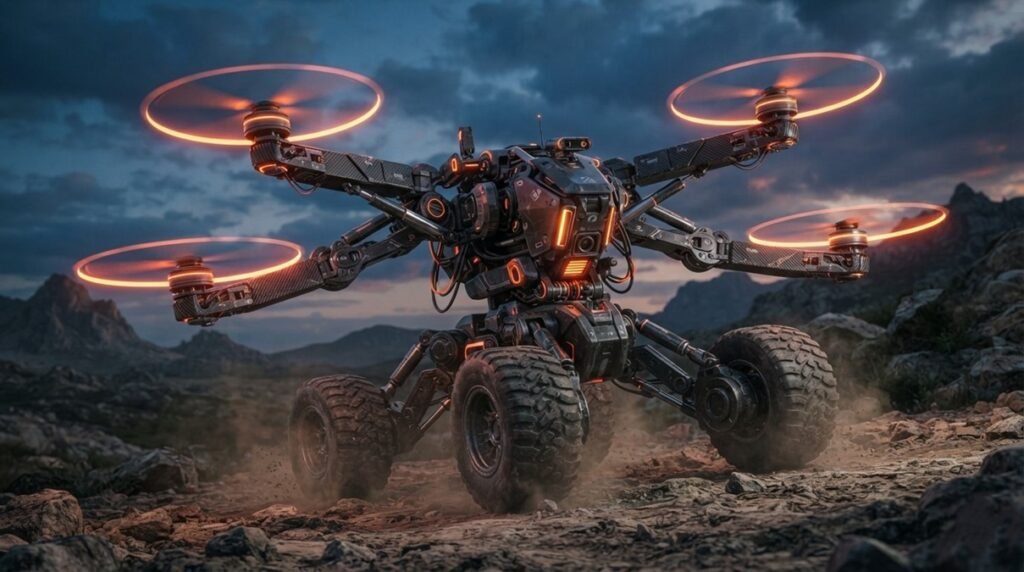
Imagine a machine that drives like a car and flies like a drone, shifting its shape automatically to conquer any terrain.
🚨 Traditional mobile robots face severe limitations because they are restricted to either ground-based rolling or aerial flight, making complex terrains impassable. Wheeled machines get trapped by debris, while standard drones drain their batteries within minutes, limiting their operational range.
💡 To solve this friction, researchers developed an innovative modular reconfigurable aerial-ground platform that combines driving endurance with flight versatility. This autonomous vehicle physically transforms its structural frame on the move, allowing it to adapt to obstacles without human intervention.
The Fatal Flaw of Modern Robot Designs
- 🛑 Traditional automated vehicles fail to navigate unpredictable catastrophe zones because their fixed structures cannot adapt to sudden physical barriers and collapsed structures.
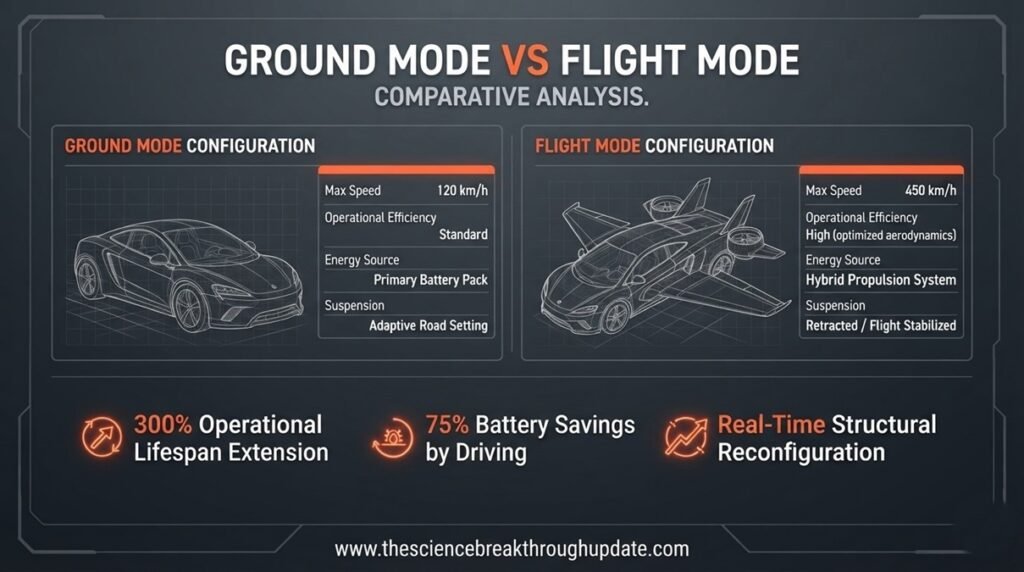
- 🔋 Standard aerial drones waste over 75% of their battery capacity just staying airborne, making long-distance field exploration completely impossible.
- 🪨 Terrestrial rovers consume less power but get permanently immobilized when encountering large vertical obstacles, deep trenches, or steep topographical drops.
- 🔧 Current hybrid models require manual component swaps, which completely eliminates their efficiency and prevents true autonomous deployment in danger zones.
The Shape-Shifting Engineering Breakthrough
- ⚙️ The research team engineered a modular system that dynamically changes its physical configuration to switch between driving and flying modes instantly.
- 🧠 Advanced onboard processing algorithms analyze environmental hazards in real time, allowing the machine to choose the most energy-efficient path forward.
- 🏎️ Passive wheel mechanisms handle smooth surfaces with minimal power consumption, while high-efficiency rotors deploy automatically when the robot needs to take flight.
- 🔒 Internal locking joints ensure structural rigidity during high-impact landings, protecting the delicate onboard sensors and computation modules from damage.
How This Transformed Field Operations
- 📈 Combining both locomotion methods extends the operational lifespan of the machine by up to 300% compared to standalone quadcopters.
- 🦺 Search and rescue teams can deploy these adaptive units into unstable environments to locate survivors without risking human lives.
- 🗺️ Environmental scientists gain the ability to map dense forests and rocky volcanic fields that were previously completely inaccessible.
- 💼 The modular architecture allows operators to swap specialized sensor payloads easily, making it a universal tool for industrial inspections.
My Take: Overcoming drone battery drainage by switching to passive ground wheels is incredibly practical. This clever hybrid design finally solves land-and-air navigation bottlenecks, fundamentally upgrading how we handle complex disaster rescue missions.
Reader Doubts: Core Questions Answered
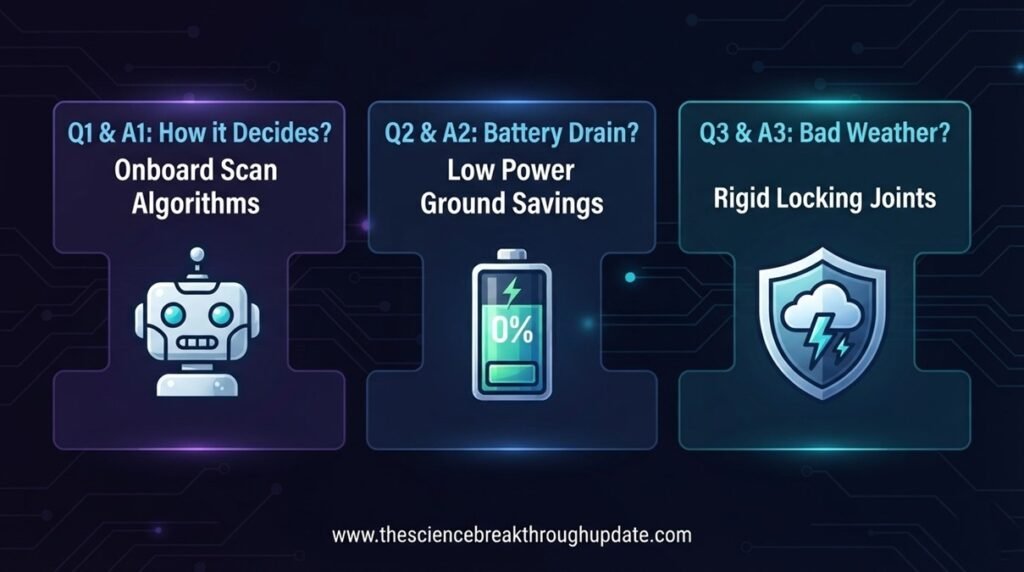
1. How does the robot decide when to fly or drive?
🤖 The platform uses advanced onboard algorithms to scan the terrain ahead. If it detects an impassable obstacle, it automatically triggers the transformation sequence to fly over it.
2. Does shifting shapes drain the battery quickly?
📉 No, the mechanical transformation consumes very little energy. Driving on the ground saves massive amounts of power, which easily offsets the brief energy spikes needed for flight.
3. Can this technology be used in bad weather?
🛡️ The rigid, locking joints are designed to withstand moderate wind and dust. Its dual-mode capability allows it to land and drive if air conditions become too severe for flight.
Source Document Link: arXiv.org
Share this useful knowledge with your friends now!”
Disclaimer: This content is for educational and informational purposes only.