


Online readers face a constant barrage of misleading clickbait headlines that distort actual news facts just to steal your clicks.
📱 Digital media platforms regularly sacrifice journalistic integrity by using sensationalized titles that trick audiences into clicking links. This widespread practice severely damages public trust in digital journalism and creates massive frustration for everyday internet users seeking accurate information. Editors frequently struggle to balance the need for high reader engagement with the ethical requirement of maintaining absolute factual accuracy.
📰 Researchers publishing in the journal Scientific Reports have developed a dual-guidance large language model system that fixes this digital dilemma. This new framework uses a constrained generation algorithm that automatically evaluates headline attractiveness while strictly cross-referencing the core facts of the story. The system optimizes titles for maximum engagement without allowing the AI to invent sensationalized or misleading claims.

The Hidden Cost of Deceptive Digital Headlines
- 🛑 News publishers routinely deploy exaggerated titles to survive in the fierce attention economy, which systematically destroys media credibility across the entire digital ecosystem.
- 📉 Traditional automated filters consistently fail to stop clickbait because they cannot balance reader curiosity with strict factual alignment during the generation process.
- 😫 Audiences regularly experience severe digital fatigue and long-term disengagement after repeatedly clicking links that fail to deliver on their headlining promises.
- ⚠️ Deceptive headlines accelerate the viral spread of online misinformation by encouraging users to share articles based entirely on unverified, sensationalized, and emotionally manipulative titles.
How the Dual-Guidance AI Rewrites the Rules
- ⚙️ The new AI architecture utilizes a two-pronged evaluation matrix to score both reader interest and factual compliance simultaneously before producing text.
- 🔒 The system applies strict semantic constraints that prevent the model from generating unsupported emotional triggers or exaggerations during live content creation.
- ✍️ Editors can now instantly generate multiple catchy title variations that remain 100% faithful to the underlying facts of the news report.
- 📈 The framework incorporates a dynamic reward-scoring algorithm that continuously penalizes misleading phrases while prioritizing clear, highly informative, and engaging human speech patterns.
Restoring Truth to the Global News Feed
- 🤝 Implementing this dual-guidance system allows global media networks to rebuild long-term reader loyalty through verified, honest, and reliable public communication.
- 🌐 Social media feeds will see a measurable drop in viral misinformation as major platforms adopt fact-constrained headline generation for syndicated content.
- 🛡️ The technology protects vulnerable online audiences from dangerous political and financial traps hidden behind manipulative and predatory online clickbait.
- 📊 Media houses can dramatically lower their operational editorial overheads while maintaining premium journalistic standards and maximizing ad revenue through genuine clicks.
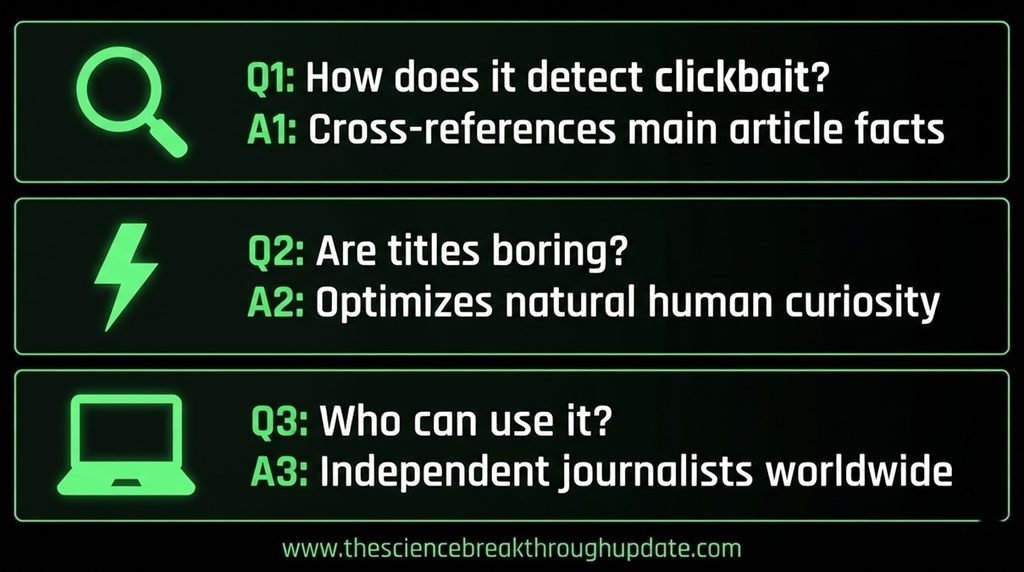
Reader Doubts: Core Questions Answered
1. How does this AI detect clickbait so accurately?
🔍 The system does not just look for bad words or sensational phrases. It mathematically compares the generated headline directly against the verified facts documented inside the main article text. If a headline introduces outside drama, exaggeration, or unverified claims, the system flags the variance and rejects the title immediately.
2. Will this technology make news titles boring for readers?
⚡ No, the system is engineered to optimize both engagement and honesty simultaneously. The AI is specifically trained to identify sophisticated language patterns that human readers naturally find interesting, curious, and urgent. It creates high-quality, professional headlines that capture attention while remaining completely honest.
3. Can independent journalists use this tool?
💻 Yes, the open framework is designed to integrate easily into standard content management systems used by writers worldwide. Independent journalists and small newsrooms can use it to polish their titles before publishing. This ensures small blogs meet the highest standard of professional journalism without requiring massive budgets.
My Take: This framework offers a much-needed correction for online journalism by forcing algorithmic honesty, proving that digital publishers can finally capture user attention without relying on cheap, manipulative lies.
News source link: Nature Paper Link
Share this useful knowledge with your friends now!
Disclaimer: This content is for educational and informational purposes only.



