💡 Your pet cat shares a hidden evolutionary blueprint with the world’s most fearsome prehistoric predators.
🐱 Scientists traditionally struggled to map how diverse cat-like carnivores developed distinct survival strategies. Understanding the precise relationship between a mammalian predator’s body mass and its specialized hunting teeth remained a persistent puzzle for evolutionary biologists. This gap limited our understanding of ancient ecosystems.
🧬 A breakthrough study finally clarifies this long-standing biological mystery. By analyzing massive datasets of living and extinct feliform species, researchers mapped distinct evolutionary pathways. This data reveals how nature forces flesh-eating mammals into specific ecological roles, transforming our view of carnivore adaptation.
The Complex Puzzle of Carnivore Jaw Evolution
- 💀 Evolutionary biologists long noticed massive structural differences in predator skulls but lacked a unified framework to explain these divergent physical traits.
- 🥩 Many ancient carnivores developed oversized teeth or massive bodies without clear patterns, leaving researchers confused about natural selection pressures.
- ⚖️ Limited fossil data often prevented scientists from tracking how predatory mammals balanced their physical weight with their killing tools.
Mapping the Three Distinct Adaptive Zones
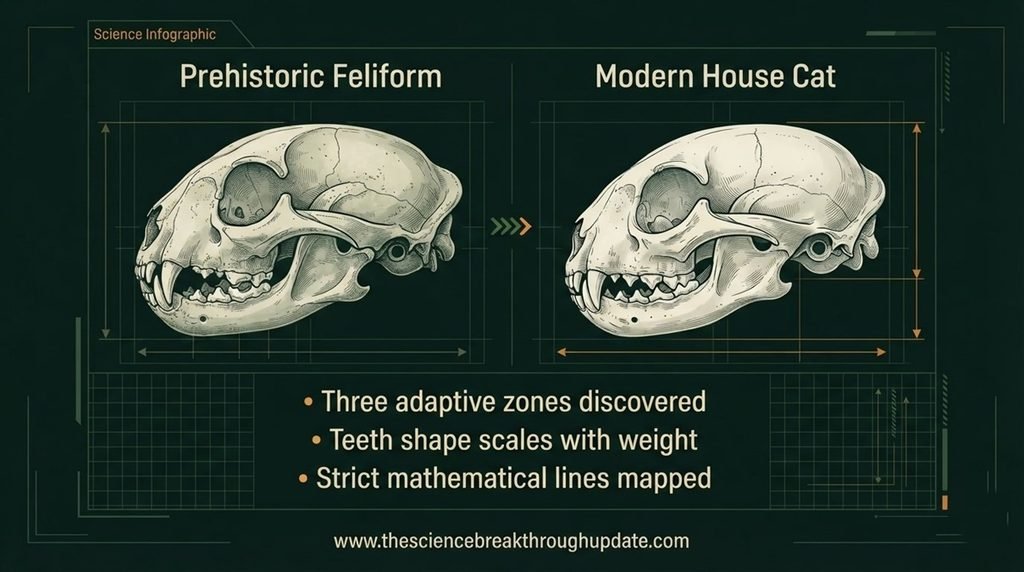
- 🔬 Scientists Paul Z. Barrett and Samantha S. B. Hopkins resolved this mystery by analyzing skull metrics from hundreds of fossil specimens.
- 📖 Their comprehensive research published in Nature Ecology & Evolution successfully identified three unique, highly specialized physical pathways called adaptive zones.
- 📐 The data proves that feliforms evolved along strict mathematical lines to optimize either rapid biting speed, crushing power, or extreme flesh-shearing capabilities.
How This Discovery Reshapes Modern Zoology
- 🦁 This landmark discovery allows modern zoologists to accurately predict the hunting habits of newly discovered fossil carnivore species.
- 🌿 Understanding these ancient biological boundaries helps conservationists protect vulnerable modern predators by analyzing their ecological dependencies.
- 🌍 The study fundamentally redefines our broader understanding of how environmental factors shape the physical bodies of apex predators.
Frequently Asked Questions
- What exactly are feliforms?
- 🐆 Feliforms represent a major suborder of carnivorous mammals that includes modern cats, hyenas, mongooses, and civets. The group also encompasses diverse extinct families like the famous saber-toothed cats. They all share specific biological traits, particularly in their auditory bullae and skull structures, which clearly separate them from dog-like carnivores worldwide.
- How do teeth change based on predator body size?
- 🦷 As a predator species grows larger over evolutionary time, its jaw mechanics must alter to handle larger prey items. Smaller feliforms often maintain versatile teeth for a varied diet of insects and small rodents. In contrast, massive species evolve specialized, highly efficient slicing teeth to maximize meat consumption while minimizing energy expenditure during hunts.
- Why does this evolutionary study matter today?
- 🗺️ This research provides critical insights into how modern ecosystems maintain stability between predators and prey over long periods. By understanding the physical limitations and evolutionary boundaries of modern felines, wildlife biologists can better anticipate how current climate shifts might impact predator survival. It proves that changing environments directly dictate animal anatomy across generations.
My Take: Mapping these strict evolutionary tracks strips away the guesswork, letting us read deep history directly from ancient bone shapes to protect living carnivores effectively.
News source link: Nature Ecology & Evolution
Share this useful knowledge with your friends now!
Disclaimer: This content is for educational and informational purposes only.