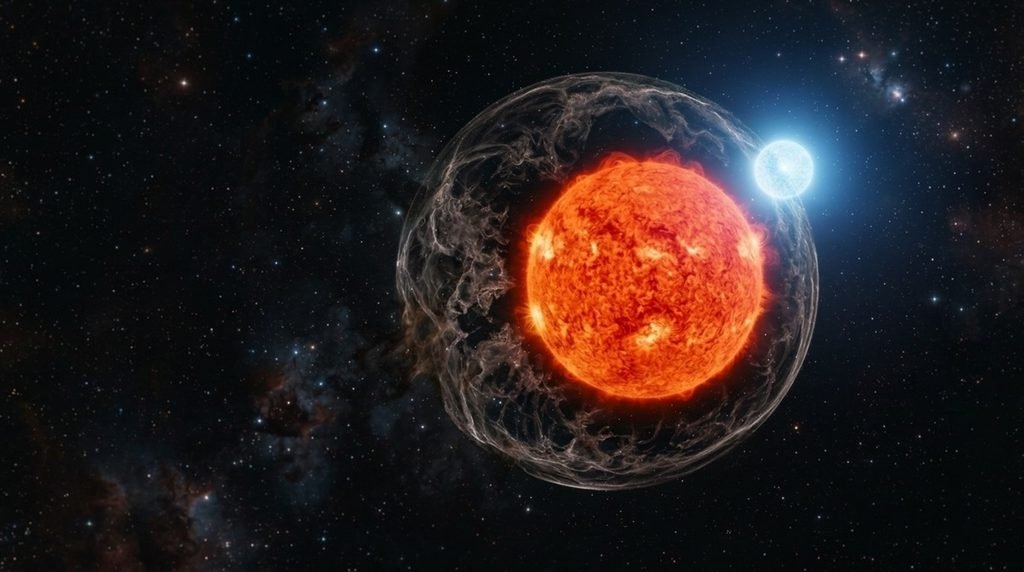
🚨 A dying cosmic monster thousands of times larger than our sun is shedding its outer layers, completely challenging everything we know about stellar death.
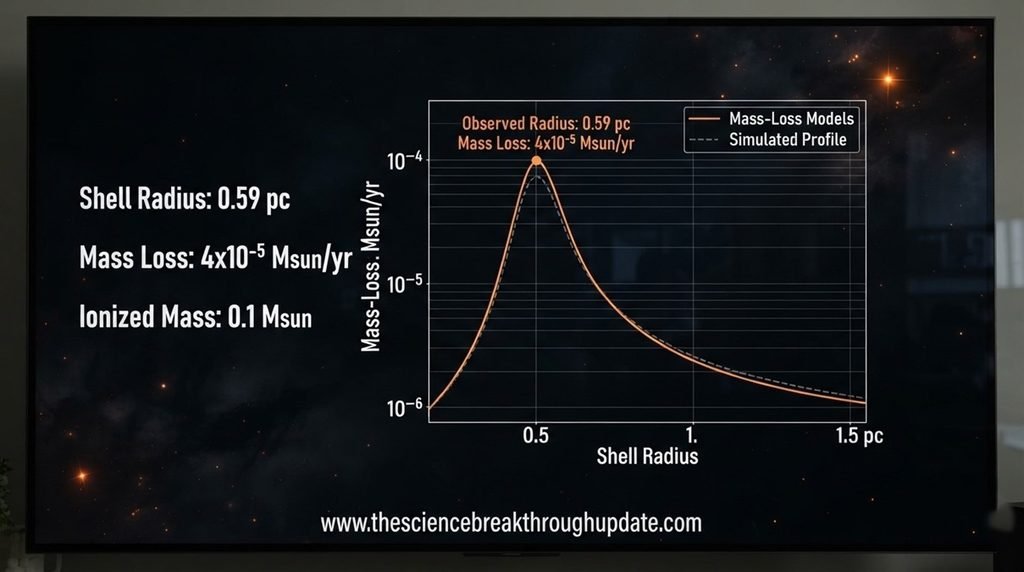
Astronomers just found a massive, parsec-scale cosmic shell surrounding the hypergiant star VX Sagittarii. This giant structure spans over 0.59 parsecs across the vast emptiness of deep space, making it the largest circumstellar nebula ever recorded around a dying red supergiant.
Lead researcher Julian Shapiro from the University of California, Berkeley discovered this immense bubble using high-resolution surveys. This unexpected discovery completely disproves old theories about how these cosmic giants behave right before they collapse in violent supernova core-collapse events.
🌌 Decades of Confusion Surrounding a Dying Celestial Monster
- Astrophysicists struggle to classify the true nature of the hypergiant VX Sagittarii because its distance and size measurements vary wildly across historical academic observations.
- This massive celestial monster exhibits strange Mira-like variations and unusual spectral lines that completely defy our standard textbook models of red supergiants.
- Conflicting data led several prominent researchers to argue that the star represents a rare, lower-mass super-AGB star instead of a hypergiant.
- Intriguing alternative theories suggest this cosmic beast could actually be a Thorne-Zytkow Object that contains a degenerate neutron core inside its deep envelope.
🔭 Mapping the Giant Bubble to Unlock Stellar Secrets
- California researcher Julian Shapiro used data from the SuperCOSMOS H-alpha Survey to isolate and accurately map the massive glowing arc around the star.
- The detailed geometric analysis revealed a giant circumstellar shell containing ionized gas equal to roughly 0.1 times the total mass of our sun.
- By calculating the precise kinematic age of the surrounding Sgr OB1 association, the single researcher successfully ruled out the restrictive super-AGB star theory.
- The slow peculiar velocity of 12 kilometers per second proves this cosmic bubble is steady stellar wind lit up by a hot neighboring OB-type star.
💥 How this Enormous Discovery Changes Galactic Physics
- The newly discovered arc provides a pristine cosmic testing ground for astrophysicists to finally confirm the existence of hypothetical Thorne-Zytkow Objects.
- Advanced high-resolution spectroscopy of the shell can detect heavy element enrichment like cosmic krypton and selenium to reveal the star’s hidden core.
- The measured mass-loss rate of 4 x 10^-5 solar masses per year forces global theoretical astrophysicists to completely revise their formulas for stellar evolution.
- This massive cosmic shell will eventually shape the final structure of the supernova remnant when the monster star undergoes its inevitable core collapse.
My Take: Finding this giant gas shell shows how little we actually know about dying hypergiants. It rips up old astronomy models and hands us a practical roadmap to solve a 50-year-old cosmic mystery.
❓ Reader Doubts: Core Questions Answered
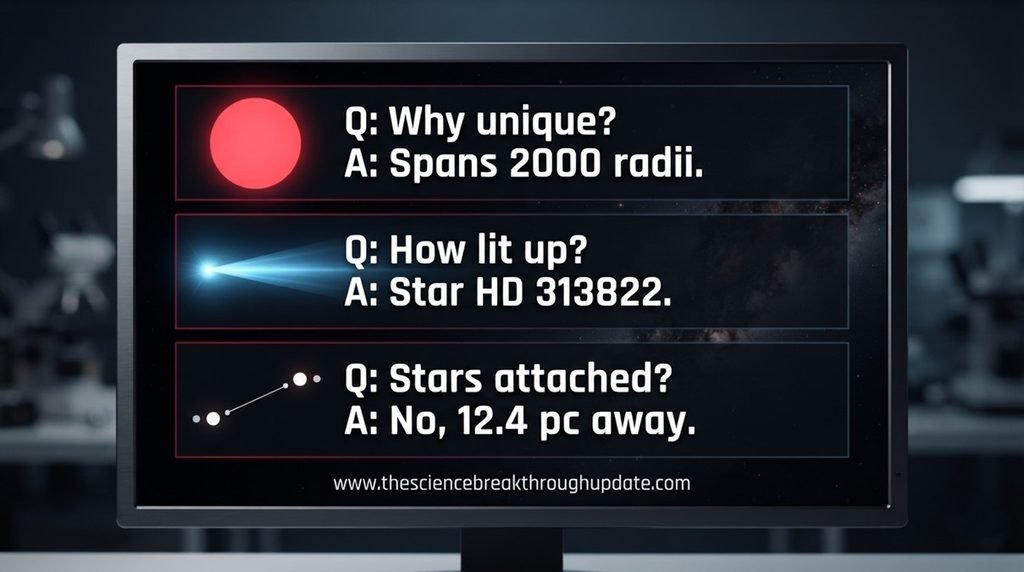
- What makes the star VX Sagittarii completely unique compared to normal stars in the Milky Way?
This stellar monster is one of the largest known stars in our galaxy, stretching up to 2000 times the actual radius of our sun. Lights from recent studies show it puzzles astronomers with its highly unusual atmospheric pulsations and unique chemical signatures. The discovery of its surrounding gas bubble cements its status as an extreme astronomical anomaly. - How exactly did a hot neighboring star light up this massive interstellar gas bubble?
The hypergiant star continuously sheds its outer atmosphere as steady stellar wind over thousands of years. A nearby hot, massive OB-type star known as HD 313822 blasts the surrounding region with intense radiation. This energetic light ionizes the flowing gas, causing the entire parsec-scale shell to glow brightly. - Can studying this newly discovered shell prove the existence of Thorne-Zytkow Objects?
Yes, the massive cosmic bubble acts as a pristine time capsule that preserves the chemical history of the star’s atmosphere. Researchers can use advanced instruments to look for high concentrations of elements like rubidium and selenium inside the gas. Finding these elements would finally confirm a famous theoretical astrophysical prediction.
Source Document Link: arXiv.org
Share this useful knowledge with your friends now!”
Disclaimer: This content is for educational and informational purposes only.