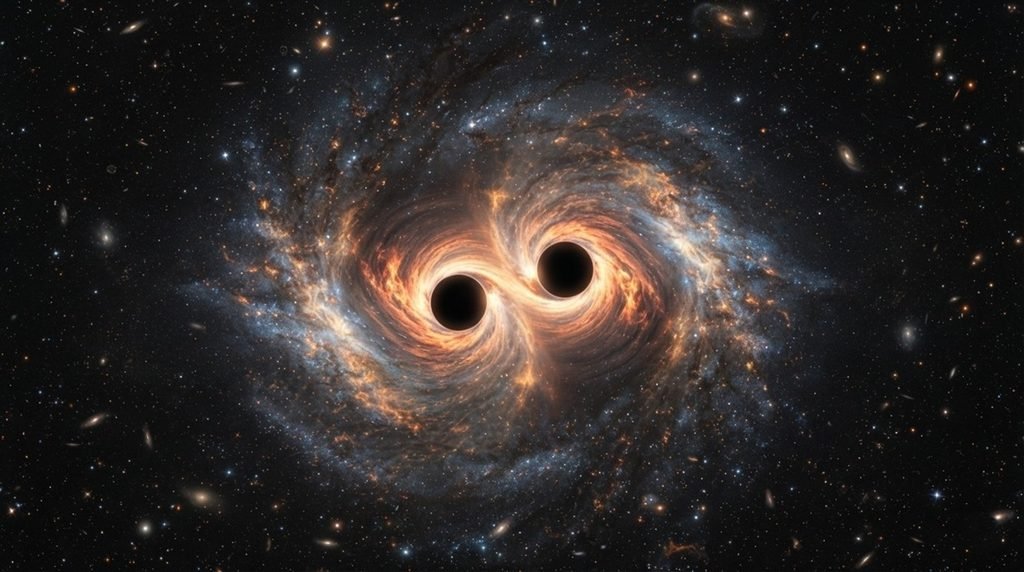
🌌 Two supermassive black holes are locked in a cosmic dance at the center of a distant galaxy, and their final collision will soon shake the fabric of spacetime itself.
Astronomers just discovered a hidden population of dual supermassive black holes lurking incredibly close to one another. These giant cosmic monsters reside inside the dense cores of active galaxies, slowly pulling each other into an inescapable gravitational death spiral.
Finding these closely paired giants remains a massive challenge because traditional optical telescopes cannot separate their individual light signatures. This major scientific breakthrough helps us understand how galaxies evolve and merge throughout the history of the deep universe.
🌌 The Hidden Challenge of Spotting Deep Space Monster Pairs
- Optical telescopes struggle to resolve dual cosmic structures because intense interstellar dust and gas clouds completely block our visible light observations.
- Most known binary pairs remain widely separated, leaving a massive gap in our understanding of how these monsters behave during close-range interactions.
- Merging galaxies produce massive amounts of radiation that easily confuse standard detectors, making it nearly impossible to confirm true binary systems.
- Astronomers desperately need precise high-resolution cosmic tracking systems to catch these closely separated giants before they finally collide and merge into single giant objects.
📡 How Scientists Cracked the Cosmic Code Using Radio Waves
- Lead researcher Emma Schwartzman and a team of astronomers utilized the highly precise Radio Fundamental Catalog to screen for potential deep-space binary candidates.
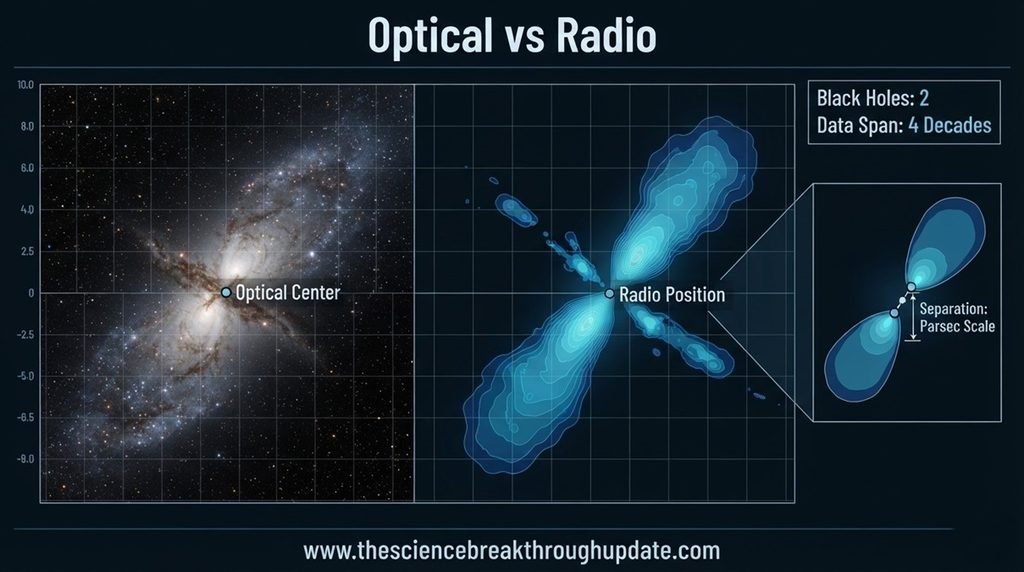
- The research team specifically targeted compact radio sources showing distinct dual signatures to isolate the most promising closely separated systems.
- This unique screening method successfully revealed a brand-new sample of closely separated dual active galactic nuclei candidates across the sky.
- The team identified these high-probability objects by leveraging four decades of high-resolution observations capable of resolving parsec-scale structures.
💥 Why This Discovery Rewrites Our Entire Understanding of Galactic Growth
- Confirming these close pairs proves that massive cosmic structures merge far more frequently than previous theoretical models originally predicted.
- These uniquely tight binary candidates provide the perfect natural laboratories for studying the final stages of intense black hole evolution.
- The impending collision of these giant objects will generate immense gravitational waves that future space-based detectors can easily map.
- This new sample allows astronomers to accurately calculate how merging galactic cores actively shape the surrounding star-forming environments.
My Take: Finding these hidden monster pairs proves our current maps of cosmic evolution are vastly incomplete. This tracking method finally gives us a front-row seat to the ultimate galactic collisions.
❓ Reader Doubts: Core Questions Answered
- What exactly are dual active galactic nuclei?
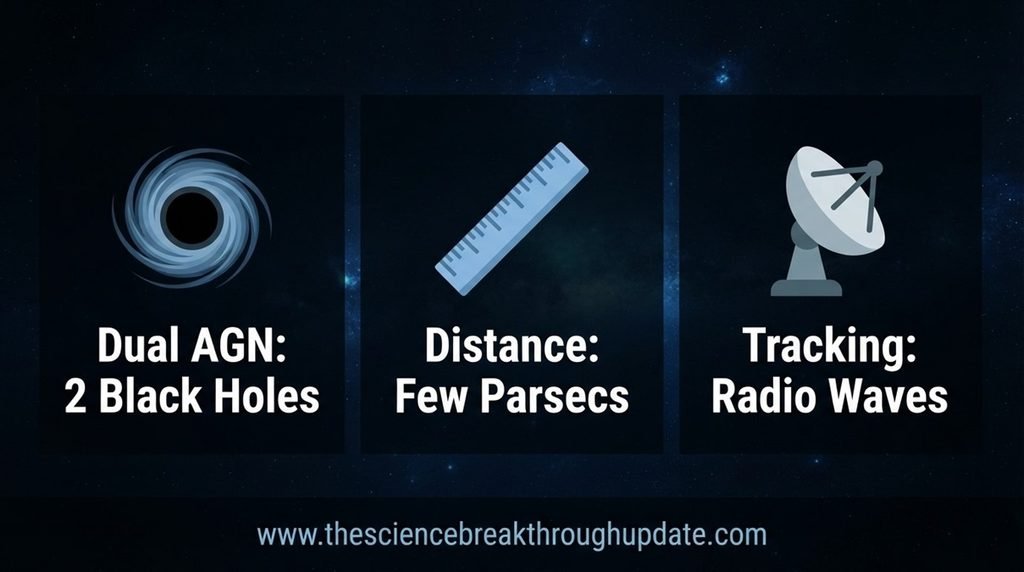
Dual active galactic nuclei occur when 2 separate supermassive black holes actively feed on matter inside merging galaxies. This process generates immense amounts of energy across multiple light wavelengths. - How close are these newly discovered pairs?
These cosmic candidates feature incredibly small physical separations, often located just a few hundred parsecs apart from each other. This tight spacing means they are in the advanced stages of merging. - Why do scientists use radio waves to find them?
Radio waves easily penetrate the thick shrouds of cosmic dust that block visible light. This allows astronomers to map the precise positions of active galactic cores with extreme accuracy.
Source Document Link: arXiv.org
Share this useful knowledge with your friends now!”
Disclaimer: This content is based on preliminary scientific research (Preprints) from arXiv.org and current global findings. It is shared strictly for educational and informational purposes and does not constitute professional, legal. Readers are encouraged to verify facts independently and consult relevant experts before making any decisions.