💍 Your jewelry might contain traces of ancient cosmic collisions that happened deep in space.
Astronomers have long struggled to pinpoint the exact locations where our universe manufactures heavy elements like gold and silver. Traditional space models focus almost entirely on old, metal-poor cosmic halos, leaving the origin of these precious metals inside our own Galactic disk largely unexplained.
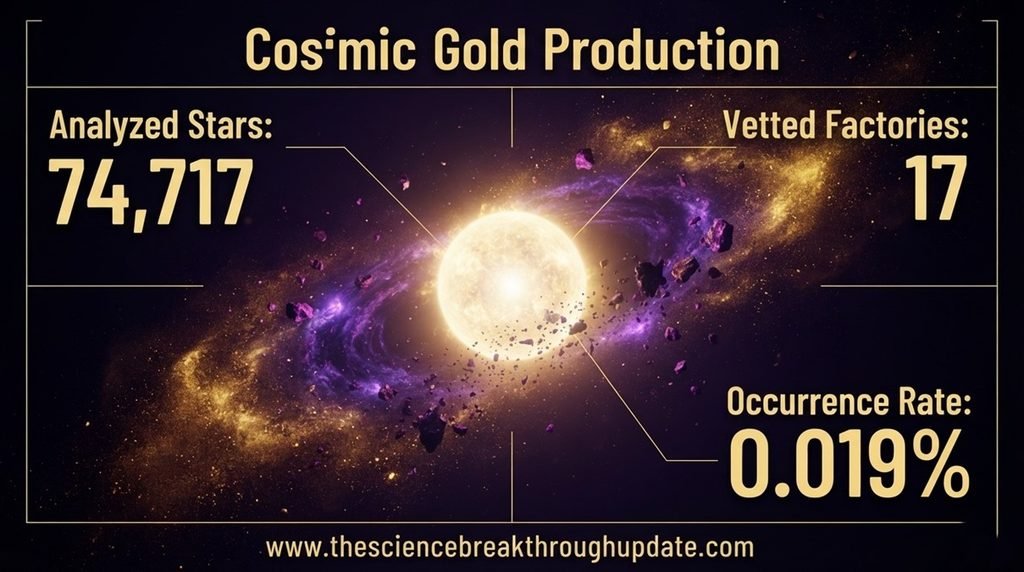
Now, a team of researchers using advanced data networks has finally cracked this cosmic mystery open by tracking rare chemical signatures. By analyzing tens of thousands of stars, they discovered seventeen unique enriched stars hidden right in our neighborhood.
🌌 The Mystery of the Galaxy’s Missing Heavy Metals
- Standard astronomical models cannot explain how heavy elements developed inside the younger, metal-rich regions of the Milky Way disk.
- Finding these critical chemical signatures remains nearly impossible because heavy element spikes are incredibly rare in nearby star systems.
- Heavy elements like europium leave faint spectroscopic footprints that automated software systems regularly misidentify or smooth out entirely.
- Scientist Sarah G. Kane notes that deep space exploration requires a clear map of chemical history across all galactic zones.
🔬 Hunting Cosmic Gold with Spectral Synthesis
- Researchers from the University of Cambridge isolated 17 distinct star systems showing extreme heavy element enrichment.
- The team combed through 74,717 stars in the GALAH survey data using a specialized neural network structure.
- Astronomers deployed the Korg spectral code to reconstruct light waves and confirm the precise chemical density of each candidate.
- The processing pipeline proved that 14 stars are explicitly loaded with elements forged in violent neutron star mergers.
🗺️ Mapping the Galactic Blueprint for Future Exploration
- The discovery establishes an occurrence rate of 0.019% for these high-density metal factories inside our local space disk.
- One exceptional star registered a record-breaking europium concentration value of 1.22, marking the highest level ever observed.
- Tracking these specific elemental hot spots allows scientists to trace the exact history of precious metal production across the galaxy.
- Future spectroscopic surveys can use these newly defined metallicity-dependent criteria to locate thousands of additional metal-rich stars.
My Take: Finding stellar gold factories nearby proves our cosmic neighborhood is highly active. It connects daily life directly to space, revealing that ordinary jewelry originates from extreme, ancient deep-space collisions.
🙋 Reader Doubts: Core Questions Answered
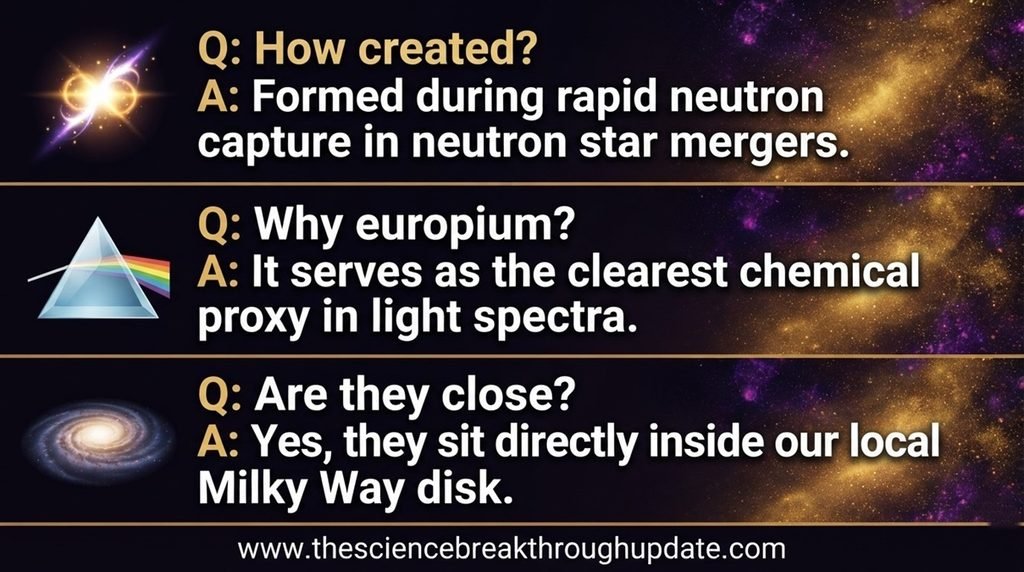
- How do stars create metals like gold and silver?
Heavy metals form during rapid neutron capture events, which occur during extreme stellar phenomena like neutron star mergers. These explosions release immense particle streams that fuse into heavy elements. - Why is europium so important to space researchers?
Europium serves as a reliable chemical proxy for other heavy metals because it leaves the clearest signatures in light spectra. Tracking it allows scientists to estimate a star’s total gold and silver content. - Are these newly discovered metal-rich stars far away from Earth?
No, these 17 stars sit directly within the main disk of the Milky Way, making them our close galactic neighbors. Their circular orbits align perfectly with the rest of our local solar neighborhood.
Source Document Link: arXiv.org
Share this useful knowledge with your friends now!”
Disclaimer: This content is based on preliminary scientific research (Preprints) from arXiv.org and current global findings. It is shared strictly for educational and informational purposes and does not constitute professional, legal. Readers are encouraged to verify facts independently and consult relevant experts before making any decisions.