🦅 Think nature always rewards teamwork? A stunning new study shows why fleeing animals sometimes survive best by completely abandoning their friends.
Scientists at Radboud University just discovered how animal groups optimize their movement against deadly threats. Traditional models show that collective flocking behaviour protects prey, but this new study proves survival depends heavily on the specific strategy the predator uses.
By analyzing digital agents, the team showed that prey survival coefficients shift drastically. Animals must constantly balance their social cohesion tendencies with sudden individual escape maneuvers to avoid being caught by fast-moving predators in simulated environments.
🚨 The Conflict Between Flocking Rules and Predator Strategies
- Traditional flocking principles do not automatically protect individuals from diverse hunting tactics.
- Predators easily exploit rigid group behaviors by changing how they target the prey flock formation during an active chase.
- The classic Reynolds boids model shows that simple local interactions govern collective movement but ignores complex multi-strategy predator scenarios.
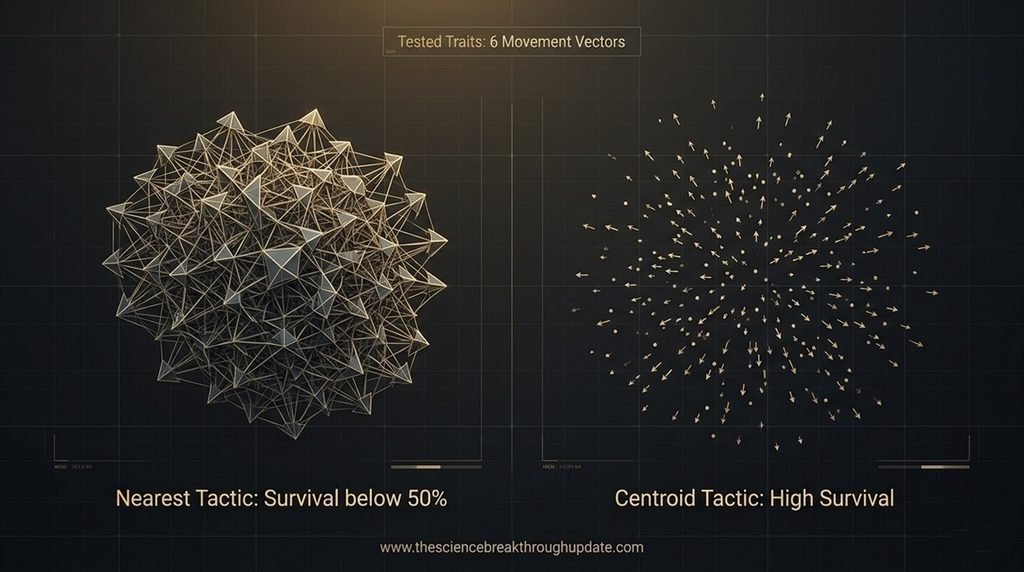
- Prey survival rates drop significantly to less than 50% when a predator switches to an attack-nearest hunting strategy.
🧬 Optimizing Collective Escape Using Evolutionary Algorithms
- Radboud University scientists Augusta van Haren, Hanna Hoogen, and Luca Pattavina combined 6 distinct prey movement tendencies together.
- The team used an evolutionary strategy algorithm to test prey survival against 4 distinct predator hunting methods over 30 generations.
- The 4 tested methods included attack-centroid, attack-nearest, attack-random, and attack-peripheral predator movement vectors.
- Prey evolved highly individualistic predator avoidance behaviors with high escape coefficients specifically when fighting the attack-centroid hunting strategy.
📈 How Evolved Coefficients Change Group Survival Dynamics
- The simulation results show that collective prey survival reaches its highest rates under the inefficient attack-centroid predator strategy.
- Prey evolved a consistently low repel coefficient across all tested predator strategies while favoring relatively high dodge and wiggle actions.
- Prey exposed to the attack-nearest predator strategy often evolved to keep their starting formation to limit total casualties.
- The revised sinusoidal wiggle behavior implementation allowed simulated prey to display much more naturalistic escape movements during high-pressure trials.
My Take: This research strips away the romanticized myth of constant teamwork in nature. Real survival requires sharp individual strategy, offering a flawless, realistic blueprint for programming tomorrow’s autonomous drone systems.
❓ Reader Doubts: Core Questions Answered
- Which predator hunting strategy is the most effective in this study?
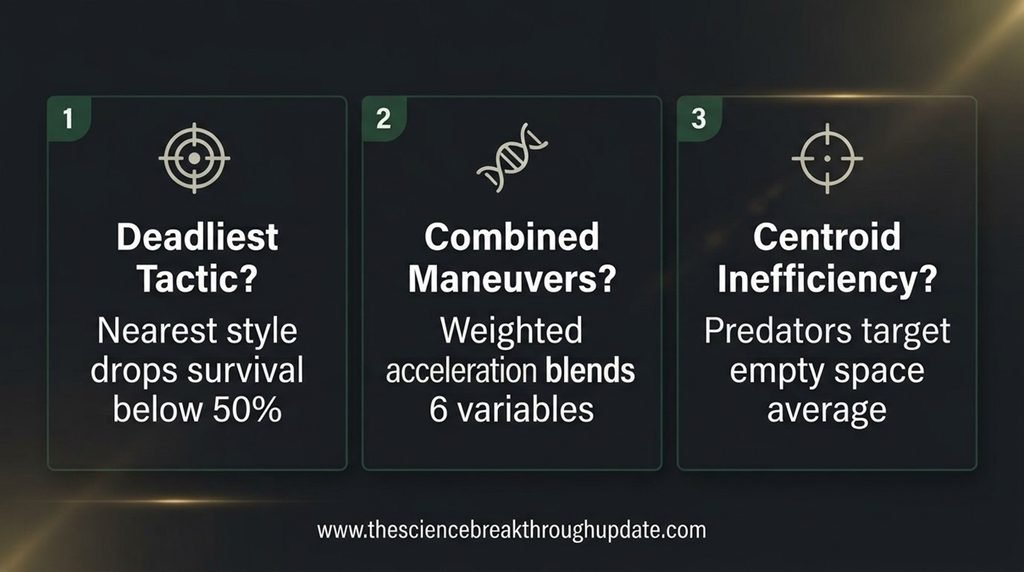
The attack-nearest strategy is reliably the most successful hunting tactic for predators. It reduces the collective prey survival rate to less than 50% in initial simulation generations before leveling off near 60%. - What are the six prey movement tendencies tested by the researchers?
The researchers combined alignment, cohesion, and separation flocking tendencies with dodge, repel, and wiggle escape maneuvers. They merged these six distinct tendencies into a single weighted acceleration update vector. - Why is the attack-centroid predator strategy inefficient for hunting?
The center mass or centroid of a flock usually does not match the actual physical position of an individual prey. This mismatch causes the predator to target empty space, allowing the prey group to achieve maximal survival.
Source Document Link: arXiv.org
Share this useful knowledge with your friends now!”
Disclaimer: This content is based on preliminary scientific research (Preprints) from arXiv.org and current global findings. It is shared strictly for educational and informational purposes and does not constitute professional, legal. Readers are encouraged to verify facts independently and consult relevant experts before making any decisions.