🌋 Something strange is happening deep inside the Earth, where solid rock behaves like liquid and magma defies the basic laws of physics.
Deep below our feet lies the asthenosphere, a soft layer of rock enabling tectonic plates to move. For decades, global geologists fiercely debated whether tiny traces of trapped fluid magma act as a hidden lubricant for these massive moving plates.
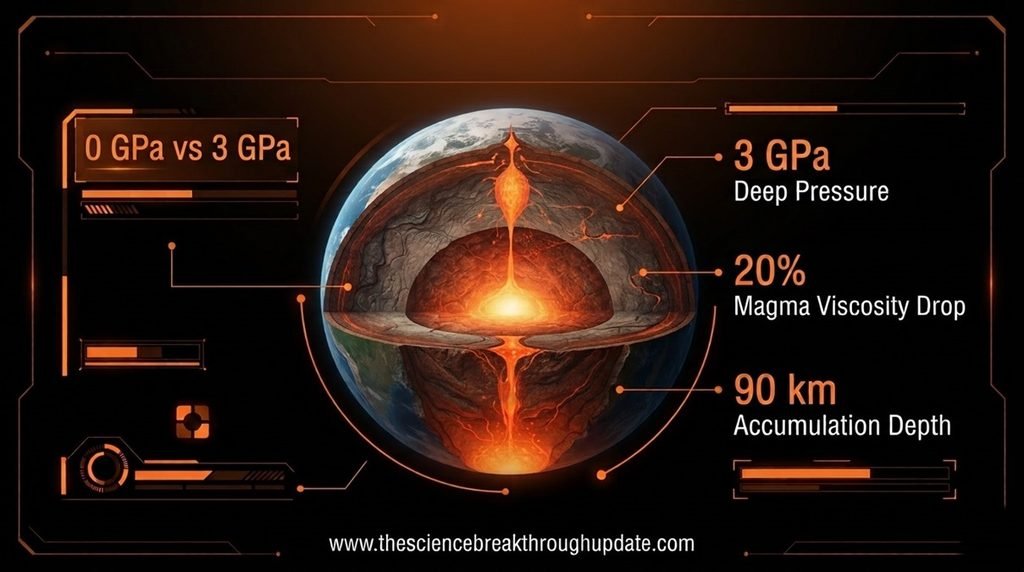
Now, a study by scientist Hongkun Zeng has solved this deep-earth mystery. Using advanced quantum physics simulations, his team mapped how magma behaves under extreme pressures, revealing an unexpected atomic phenomenon that controls volcanic transport networks.
⚠️ The Deep-Earth Mystery That Fooled Scientists For Decades
- Traditional planetary physics states that extreme gravitational pressure compresses deep materials, which normally makes underground magma thicker and far less mobile.
- However, historical field experiments paradoxically suggested that melting basaltic rock becomes significantly thinner and more fluid at deep mantle levels.
- Disbelieving critics recently dismissed these older anomalies as mere experimental errors and temperature fluctuations caused by faulty laboratory equipment during high-pressure testing.
- This widespread scientific skepticism left geologists without a verified physical mechanism to accurately explain how hidden magma channels form beneath the crust.
💻 How Quantum Supercomputers Unlocked The Secret Of Moving Magma
- Lead author Hongkun Zeng and researchers at the China University of Geosciences used advanced machine learning algorithms to supercharge molecular dynamics software.
- This advanced computational technique allowed the scientific team to accurately model deep-earth materials across 3-orders-of-magnitude longer timelines with absolute statistical precision.
- Their new simulations successfully proved that underground magma viscosity drops by 20% under 3 GPa of pressure due to specific atomic transitions.
- While silicon-oxygen structural networks remain completely rigid under compression, aluminum atoms quickly reorganize into highly flexible coordination states that accelerate flow.
🌍 Why Liquid Rock Accumulates Right Beneath Our Tectonic Plates
- As this highly fluid magma naturally ascends toward the surface, cooling planetary temperatures quickly overpower these pressure changes and drastically stiffen the molten rock.
- This sudden, dramatic thickening completely halts the upward migration, forcing the rising magma to stagnate and pool directly underneath the lithosphere base.
- This active underground accumulation creates a permanent, melt-enriched channel that perfectly matches real-world seismic wave observations collected globally by modern geophysicists.
- Ultimately, this planetary lubrication system provides the fundamental mechanical weakness that keeps Earth’s massive tectonic plates moving continuously across vast geological eras.
My Take: Proving exactly why the ground moves beneath us completely flips our understanding of planetary physics. It turns decades of geological guesswork into predictable, hard science for future volcanic forecasting.
❓ Reader Doubts: Core Questions Answered
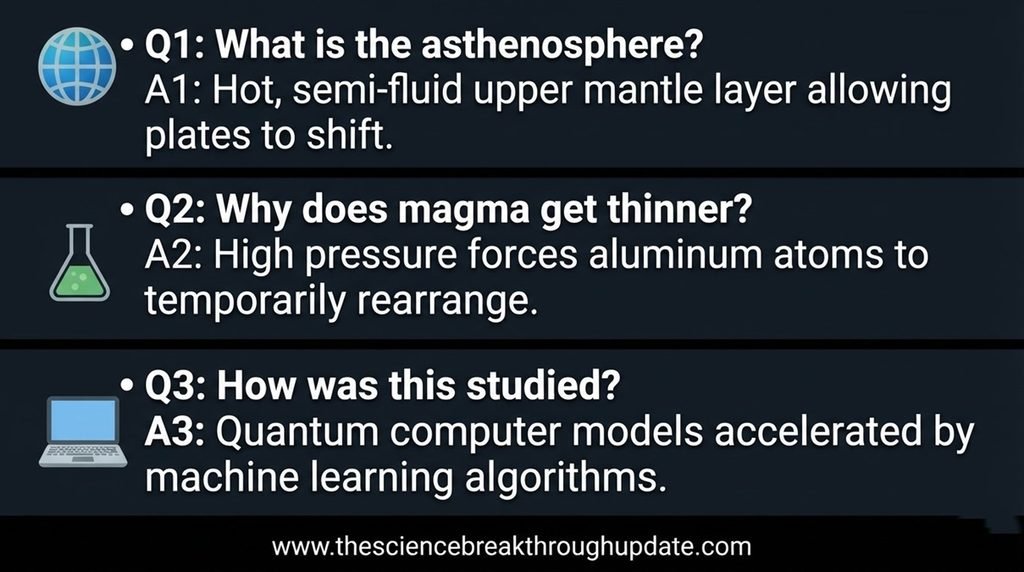
1. What is the asthenosphere and why does it matter to us?
The asthenosphere is a hot, semi-fluid layer of Earth’s upper mantle lying directly beneath the rigid outer crust. It provides the crucial lubrication that allows tectonic plates to shift, which ultimately drives planetary evolution, mountain building, and global volcanic activity.
2. Why does magma get thinner before it gets thicker deep underground?
At specific depths around 90 kilometers, extreme pressure forces aluminum atoms within the liquid rock to temporarily rearrange into highly flexible structural configurations. This atomic shift lowers viscosity by 20%, though cooling temperatures quickly reverse the effect as the magma continues to rise.
3. How did scientists study things happening 90 kilometers beneath the surface?
Since physical drills cannot survive the extreme heat at these depths, scientists used quantum-mechanical computer models accelerated by machine learning algorithms. This approach allowed the team to replicate mantle pressures up to 6 GPa with unmatched statistical precision and zero experimental artifacts.
Source Document Link: arXiv.org
Share this useful knowledge with your friends now!”
Disclaimer: This content is based on preliminary scientific research (Preprints) from arXiv.org and current global findings. It is shared strictly for educational and informational purposes and does not constitute professional, legal. Readers are encouraged to verify facts independently and consult relevant experts before making any decisions.