


🔒 Your DNA data is no longer safe online, but a new browser trick is about to lock out big tech forever.
For decades, analyzing your complex genetic code meant uploading highly private sequences directly to massive corporate datacenters. This alarming process exposes your personal biological blueprint to severe leaks and unauthorized third-party tracking networks across the internet.
Now, computer scientists have discovered a brilliant way to run complex genetic calculations right inside ordinary web browsers. This decentralized shift completely cuts out the middleman, keeping your private genomic data fully encrypted on your local machine.
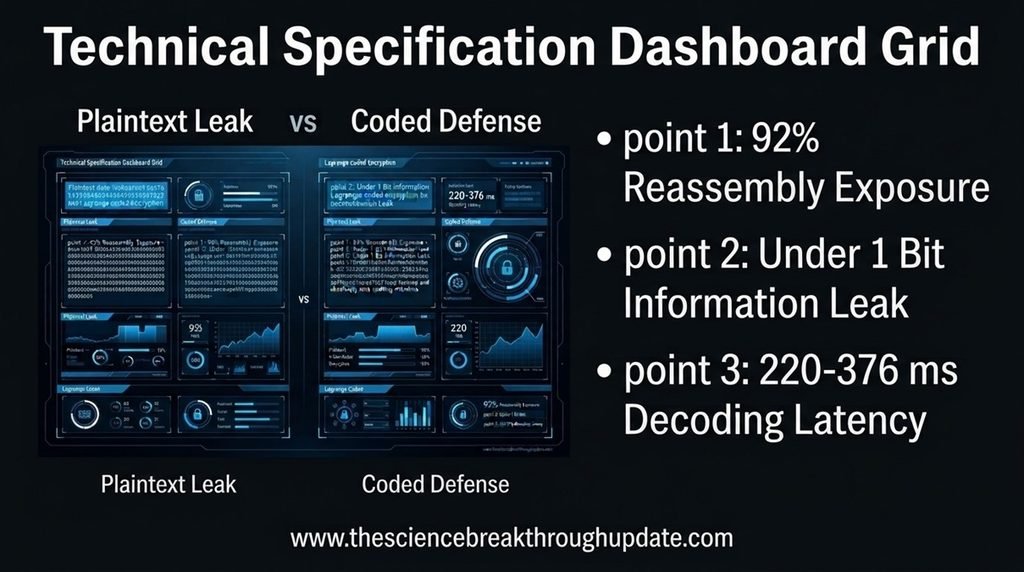
⚠️ The Hidden Danger Of Sharing Raw Genetic Sequences
- Sending raw data to centralized cloud systems exposes your sensitive DNA sequence to severe privacy risks and corporate exploitation.
- Even fragmented genetic pieces are vulnerable because one worker can identify the source genome from 300 unordered tokens with 92% accuracy.
- Standard secure inference protocols cost seconds to minutes per token, making real-time clinical analysis completely impractical on standard consumer devices.
- Large foundation models like GenomeOcean-MoE hold about 30 GB of weights, forcing small field laboratories to rely on expensive datacenter accelerators.
💻 Splitting Artificial Intelligence Across Volunteer Web Browsers
- Researchers Guang Yang and Fengchen Liu from the University of California, Los Angeles and University of California, Berkeley built this system.
- The system utilizes hand-written WGSL kernels to execute complex mathematical operations directly on local graphics processors inside headless Chrome workers.
- A specialized technique known as Lagrange coded computing splits the expert inputs into random Gaussian-padded shares before distribution.
- This defensive encryption bounds the information leak to under 1 bit per forward pass, leaving corporate data attackers completely empty-handed.
🏥 How Local DNA Processing Changes Global Healthcare Security
- Field laboratories and clinics can now screen sequences locally without exposing private DNA data to whoever owns the datacenter.
- The system maintains perfect operational fidelity, matching native llama.cpp at every single quantization level without losing accuracy.
- Distributed networks automatically absorb unexpected system crashes, allowing calculations to proceed smoothly even if 1 worker fails entirely.
- Consumer hardware running modern web browsers can instantly become safe nodes for secure collaborative inference over the internet.
My Take: By turning everyday browsers into secure shields, this tech finally strips big tech of its DNA monopoly, proving privacy and massive AI scaling can safely coexist without compromises.
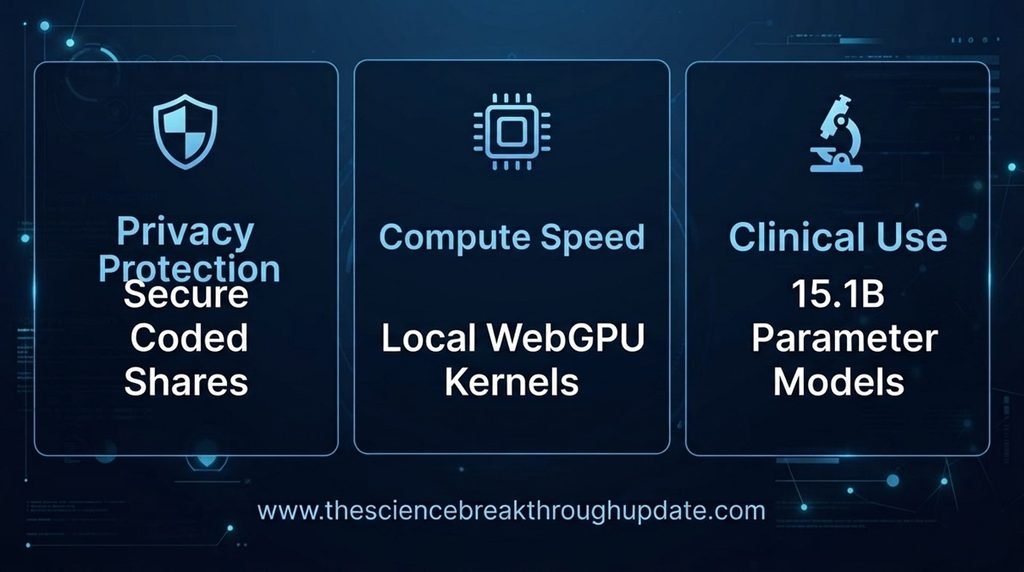
❓ Reader Doubts: Core Questions Answered
- How does this technology protect my biological privacy?
It converts your genetic data into secure, Gaussian-padded mathematical shares before outsourcing the work to browser nodes. No single external computer can reconstruct the input sequence, bounding the information leak to under one bit. - Will this local browser system slow down my computer?
No, because the workload uses hand-written WebGPU kernels that stream operations directly through the local graphics processor. In Chrome, coded decoding runs efficiently between 220 to 376 milliseconds per token depending on the configuration. - Can medical clinics use this for immediate disease diagnosis?
Yes, clinics can run large 15.1-billion-parameter genome mixture-of-experts models using ordinary web browsers. This allows resource-constrained labs to perform private genomic scoring without paying for massive local datacenter hardware.
Source Document Link: arXiv.org
Share this useful knowledge with your friends now!”
Disclaimer: This content is based on preliminary scientific research (Preprints) from arXiv.org and current global findings. It is shared strictly for educational and informational purposes and does not constitute professional, legal. Readers are encouraged to verify facts independently and consult relevant experts before making any decisions.



