


⚠️ Your daily internet lag might not be your broadband provider’s fault, but rather the silent weight of unmanaged generative AI network traffic.
Every time a user prompts a machine learning model, a hidden surge of data moves across the network, causing unpredictable traffic spikes. Traditional digital habits like streaming video follow highly structured paths, but generative AI traffic breaks all the old structural rules. These highly variable anomalies force systems to struggle, threatening the stability of global Wi-Fi networks and wireless communication infrastructure.
To tackle this invisible congestion, engineering teams at Rensselaer Polytechnic Institute and Samsung Research America designed a brand-new measurement framework. Their system, called MINT, isolates and tracks packet-level bursts to map out exactly how models interact with infrastructure. This dataset allows network engineers to properly evaluate scheduling and execute smarter long-term capacity planning mechanics.
📦 The Hidden Strain of Invisible Packet Bursts
- Traditional applications like video streaming rely on predictable download-heavy patterns that allow systems to manage bandwidth smoothly.
- Emerging artificial intelligence tools cause severe network scheduling complications by creating extreme upload and download asymmetry.
- Advanced machine learning modalities transmit data using irregular packet-level bursts that vary wildly based on server processing times.
- Network packet simulators lack real measurement-driven models, forcing researchers to approximate data using incorrect video streaming baselines.
🔍 Mapping the Microscopic Realities of Data Flows
- Researchers Andrew Nguyen and Samson Kempiak built a unique data engine to test diverse large language models.
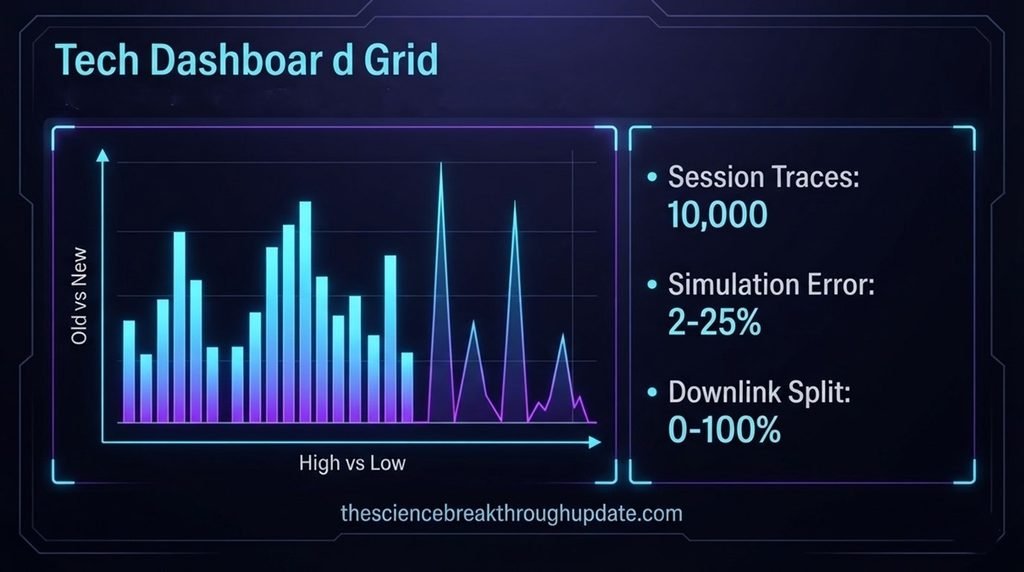
- The engineering team collected nearly 10000 client-side session traces across Ethernet, Wi-Fi, and 5G network access interfaces.
- Their pipeline successfully separated pure application behavior from transport artifacts and external wireless access network delays.
- The open-source tool evaluates critical metrics like time-to-first-response packets across cloud providers and localized edge servers.
⚡ Simulating the Next Generation of Traffic Systems
- The newly designed architecture models precise burst interarrival times with normalized Wasserstein distances ranging from 2% to 25%.
- Engineers implemented this measurement-driven logic into the open-source Network Simulator 3 program to replicate realistic user workloads.
- This software provides authentic scheduling data that outperforms the traditional, inaccurate constant token streaming models by large margins.
- Network administrators can now utilize these open-source datasets to deploy superior congestion control mechanisms across local networks.
My Take: We cannot build a smart future on an unstable foundation. MINT finally exposes how AI secretly chokes our infrastructure, giving engineers the blueprint needed to keep the internet running smoothly.
❓ Reader Doubts: Core Questions Answered
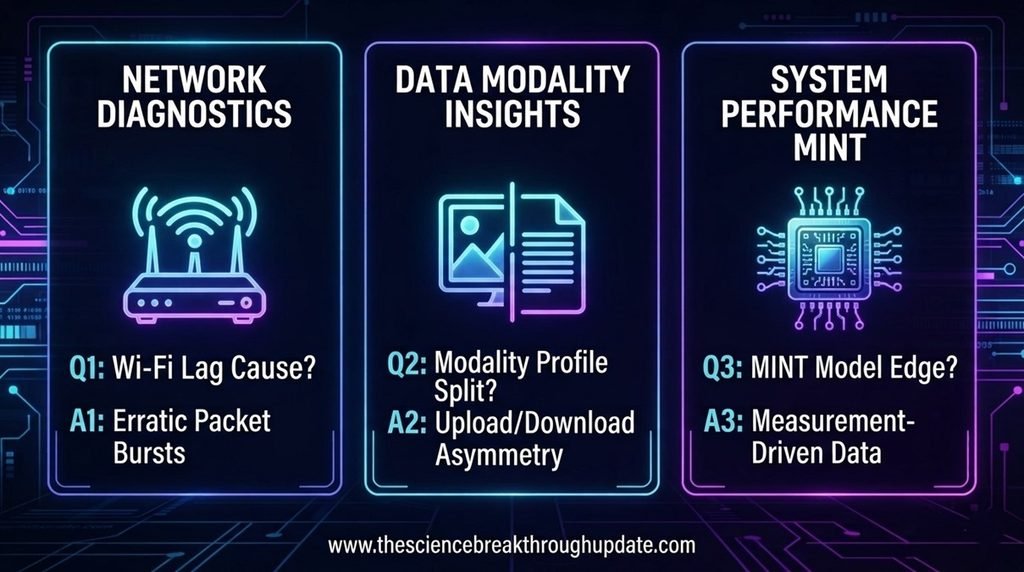
- How does using artificial intelligence create unmanaged traffic spikes on networks?
Unlike streaming video which reuses data buffers predictably, AI traffic relies entirely on prompt modalities and varying server processing times. This creates sudden, erratic packet bursts that trigger unexpected network congestion. - Do different AI modalities generate identical network data profiles?
No, data profiles change completely based on the specific modality used. Image-to-text features demand massive upload capacities, while standard text-to-text streaming creates highly sensitive, low-throughput packet intervals. - What makes the MINT framework better than older network simulation models?
Older baselines rely on constant token rates that fail to capture the true packet variability received by clients. MINT uses actual measurement-driven distributions to help engineers execute accurate infrastructure scheduling.
Source Document Link: arXiv.org
Share this useful knowledge with your friends now!”
Disclaimer: This content is based on preliminary scientific research (Preprints) from arXiv.org and current global findings. It is shared strictly for educational and informational purposes and does not constitute professional, legal. Readers are encouraged to verify facts independently and consult relevant experts before making any decisions.



