

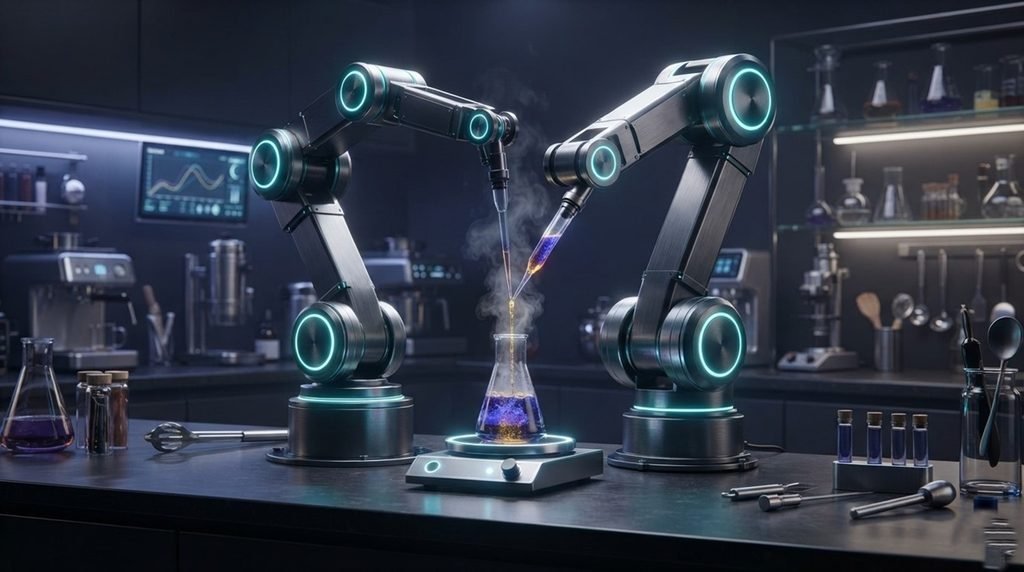
Imagine your kitchen robot perfectly pouring hot soup, straining pasta, and mixing ingredients without spilling a single chaotic drop.
🥣 Robots easily handle solid tools, but cooking messy liquid meals remains a massive challenge. Traditional home machines lack the quick intuition to predict how fluids slosh alongside hard ingredients inside moving containers. This limitation forces automation tools to remain basic and unsafe for household chores.
🧠 Researchers Yixuan Feng and Peng Wang solved this puzzle by developing a predictive physics world model. Their system trains a robotic arm to accurately anticipate fluid and solid interactions simultaneously. This allows machines to alter movements mid-air, making autonomous robot chefs precise.
Why Messy Kitchens Defeated Smart Machines
- 🛑 Traditional automated systems completely fail when handling combined fluid and solid movements because liquids shape-shift unpredictably.
- 🌊 Standard cameras cannot easily track how heavy ingredients splash inside boiling water, causing massive robotic handling errors.
- ⏳ Computations for fluid dynamics usually take hours, making real-time movement adjustments impossible for older kitchen hardware.
- 💥 A single minor miscalculation during basic straining or pouring tasks inevitably results in a costly household cleanup.
The Neural Network That Predicts Fluid Splashes
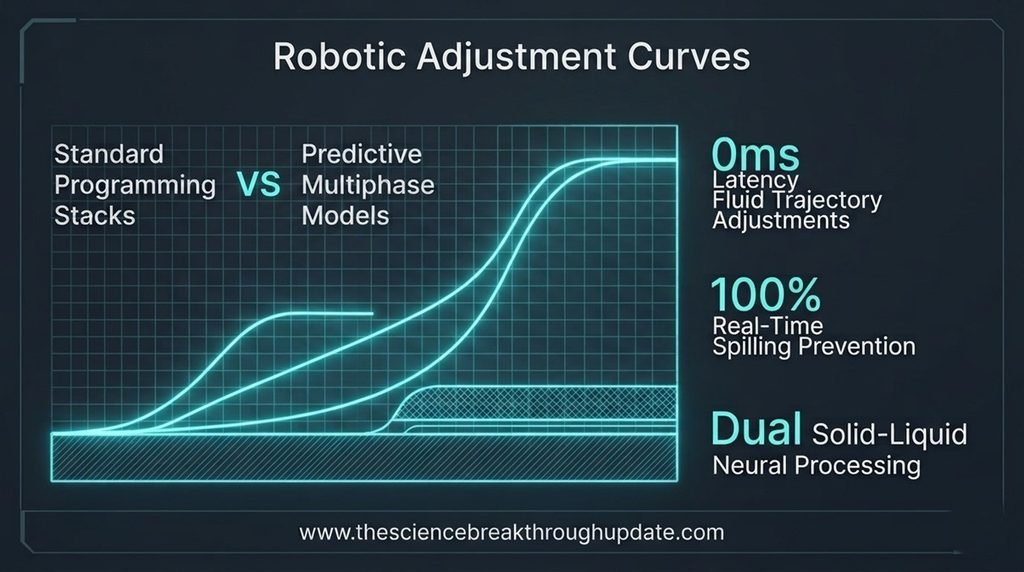
- 🛡️ The research team built a smart multiphase world model that instantly simulates how liquids and solids react together.
- 🔮 This software allows the robotic arm to visualize fluid behavior before the physical movement even takes place.
- 🔍 The system utilizes specialized visual conditioning networks to track hidden changes inside deep cooking pots seamlessly.
- 📐 By predicting splashing tendencies, the machine instantly alters its physical pouring angles to prevent any accidental drops.
How This Changes Home Cooking Forever
- 🏡 This technology paves the way for truly autonomous residential kitchens that can cook complex, multi-ingredient recipes safely.
- 📉 Commercial food preparation businesses can drastically reduce ingredient waste using these precise robotic pouring systems.
- ☣️ Advanced industrial operations can adopt these models to safely transport hazardous chemical liquids across factory floors.
- 🧼 Future household helpers will safely perform delicate chores like washing fragile dishes without requiring human supervision.
My Take: Teaching machines to predict fluid chaos shifts home automation from basic mechanical chore-doers into truly intelligent household helpers, finally bringing mess-free, fully autonomous cooking into our everyday reality.

Reader Doubts: Core Questions Answered
- Will these robot chefs spill food if the pot moves suddenly?
🛡️ No, the predictive world model constantly updates its tracking data. - Can this technology handle thick liquids like honey or gravy?
🍯 Yes, the system simulates various fluid densities. - When can consumers buy these automated kitchen assistants?
⏱️ The core software framework is complete, but consumer hardware integration takes time.
News source link: arXiv.org
Share this useful knowledge with your friends now!”
Disclaimer: This content is based on preliminary scientific research (Preprints) from arXiv.org and current global findings. It is shared strictly for educational and informational purposes and does not constitute professional, legal. Readers are encouraged to verify facts independently and consult relevant experts before making any decisions.



