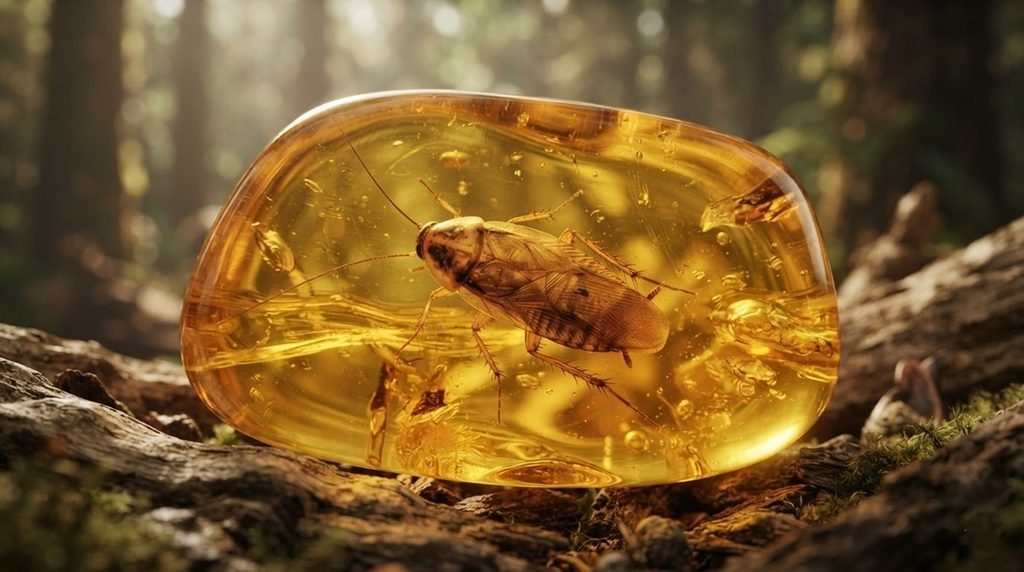
🕵️ A tiny creature trapped inside hardened tree resin for millions of years completely alters how scientists view the prehistoric ecosystem.
🌍 Paleontologists often struggle to understand the daily habits of ancient insects because flat, crushed fossils hide critical physical features. 🐜 A newly studied amber specimen from Japan changes this narrative by offering an exceptionally clear look at a prehistoric three-dimensional cockroach.
🏫 Researchers from Fukui Prefectural University successfully analyzed this pristine specimen, which reveals how ancient pests navigated their environments. 🦖 This incredible find bridges a massive gap in insect evolution, proving that certain survival traits remained unchanged since the age of giant dinosaurs.
The Hidden Mysteries of Prehistoric Night Life
- 🪨 Standard flat rock fossils heavily compress delicate insect antennae, making it nearly impossible for entomologists to determine their daily sensory behaviors or complex mating habits.
- 🌲 Scientists previously lacked concrete physical proof to confirm exactly when prehistoric roaches officially transitioned into highly specialized, night-active forest floor scavengers.
- ⛏️ Traditional destructive excavation methods frequently damage soft-bodied ancient specimens, leaving massive unresolved gaps in the global evolutionary records of prehistoric terrestrial arthropods.
Peering Through Golden Ancient Resin
- 🔬 Experienced Japanese paleontologists utilized precision microscopic thin-sectioning to safely study the internal structures without damaging the highly delicate prehistoric amber specimen.
- 💎 The scientific research team successfully identified an extinct species named Ovaliblatta iwakiensis preserved beautifully inside a flawless piece of golden translucent amber.
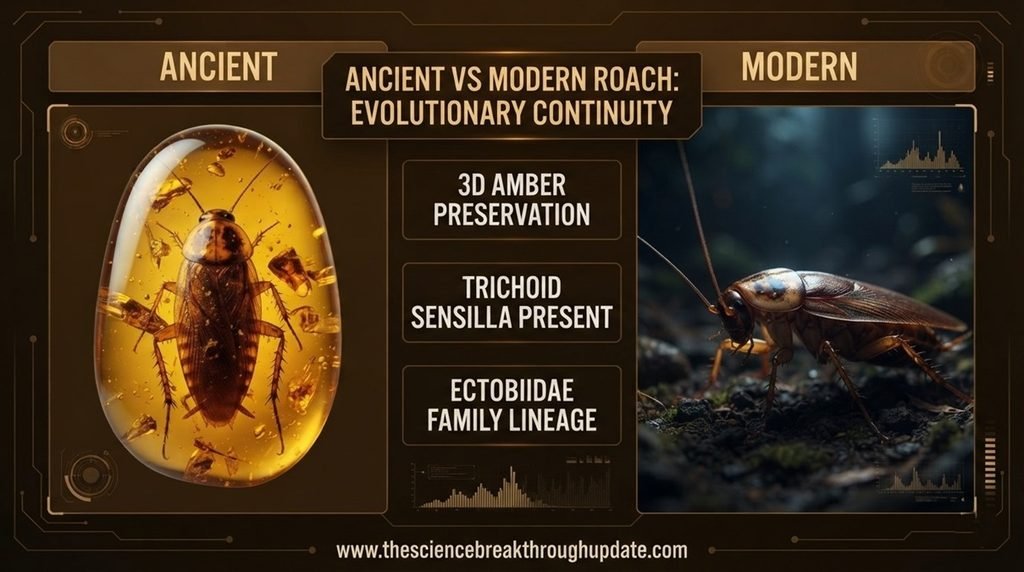
- 🔍 High-resolution optical imaging revealed specialized trichoid sensilla hairs on the antennae, perfectly matching the tactical sensory equipment found on modern wild roaches.
Rewriting the Timeline of Insect Evolution
- 🌙 The presence of these delicate sensory hairs proves that these ancient organisms possessed active, well-developed nocturnal habits during the ancient Cretaceous period.
- 🧬 This historic discovery confirms a direct biological lineage to the modern Ectobiidae family, showing that their survival mechanics perfected millions of years ago.
- 🗺️ The intact specimen provides a valuable anatomical baseline, actively helping global researchers identify similar environmental adaptations in other ancient planetary forest arthropods.

Frequently Asked Questions
1)❓ How do scientists know this insect was active at night?
💡 The beautifully preserved fossil contains intact, highly specialized microscopic sensory hairs called trichoid sensilla directly on its ancient antennae. Modern nocturnal insects rely heavily on these identical biological structures to navigate pitch-black environments without any visible light. Therefore, this physical evidence strongly confirms that the prehistoric creature adapted specifically for night-time wilderness activity.
2)❓ Why is amber preservation better than rock fossils?
🛡️ Heavy sedimentary rock fossils completely flatten small animals under immense geological pressure over millions of years, permanently destroying delicate structures. Natural tree amber hardens incredibly fast around the insect, locking its exact three-dimensional shape in place forever. This unique natural process protects internal organs, fragile leg joints, and fine surface hairs with absolute perfection.
3)❓ What does this find tell us about dinosaur ecosystems?
🌿 It conclusively proves that highly specialized nocturnal ecological niches existed long before the major extinction events wiped out ancient dinosaurs. Small insect scavengers safely worked the night shift while massive predatory reptiles fully dominated the wide daytime landscape. This clear division of labor reveals a highly complex, diverse, and organized prehistoric jungle ecosystem.
My Take: Finding these microscopic hairs reminds us that evolutionary perfection happens early. While giants shook the ground, these tiny survivalists quietly mastered the dark using tools they still rely on today.
News source link: The Japan News
Share this useful knowledge with your friends now!
Disclaimer: This content is for educational and informational purposes only.