


🚨 Security teams assume artificial intelligence can flawlessly run complex defensive networks, but a startling new trial exposes a massive syntax flaw.
Security experts increasingly trust large language models to automate threat detection by translating plain speech into actual command-line interface prompts. However, even advanced software constantly stumbles over basic terminal formatting, making simple deployment tasks highly unpredictable for modern defensive teams.
To fix this operational blind spot, researchers from Khalifa University and the University of Western Australia built a specialized verification framework. Their testing platform exposes critical interface bugs, showing that human analysts must still supervise automated scripting architectures.
💻 The Hidden Breakdown In Automated Terminal Command Translation
- General software models frequently fail because the command-line interface allows no room for tiny spelling or formatting adjustments.
- Automating simple terminal tasks becomes highly chaotic when software slips up on flag-spelling rules or basic argument ordering.
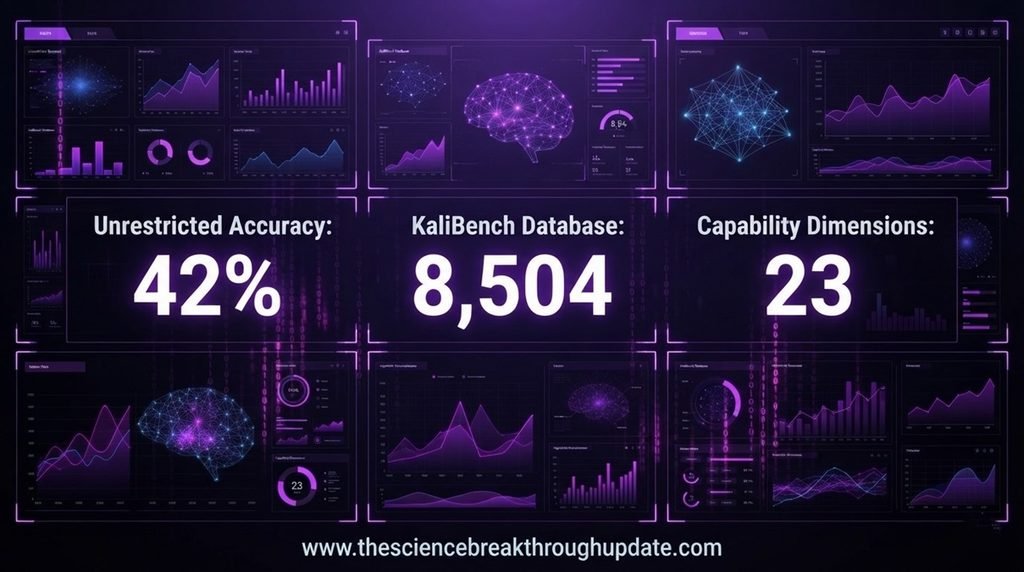
- Testing shows no open-weight model surpasses 42% exact-command accuracy when operating completely free without explicit tool hints.
- Minor execution errors like singular-plural confusion or malformed syntax options instantly break vital scripts inside active corporate environments.
🛠️ Building A Verifiable Safe Testing Ground For Systems Engineering
- Developers built a specialized translation layer called KaliBench containing 8,504 verified natural-language query-command pairs to systematically evaluate automated networks.
- The pipeline safely filters broken code snippets through sandboxed terminal execution using a Kali Linux container setup before deployment.
- Engineers use deterministic verification parameters to supply runtime-free verifiable rewards, accelerating model learning speeds without live runtime execution loops.
- This open-source pipeline systematically categorizes terminal functionality across 23 capability dimensions and 5 security phases to mirror real-world security workflows.
📈 How Smart Training Closes The Capabilities Gap For Lean Teams
- Applying supervised fine-tuning drastically reduces optional-argument prediction bugs, which traditionally remain the largest technical hurdle for automated frameworks.
- Advanced training allows an 8B model to achieve performance comparable to a 685B MoE framework using explicit training protocol.
- Standardizing output formatting structures directly limits option hallucination patterns, shielding live server environments from erratic automated actions.
- Giving autonomous tools access to documentation helps teams resolve intent decomposition problems without relying on giant external server infrastructure.
My Take: This exposure humbles the AI hype. Forcing models into unforgiving terminal realities proves that safety still demands human eyes; raw scale matters less than precise engineering.
❓ Reader Doubts: Core Questions Answered
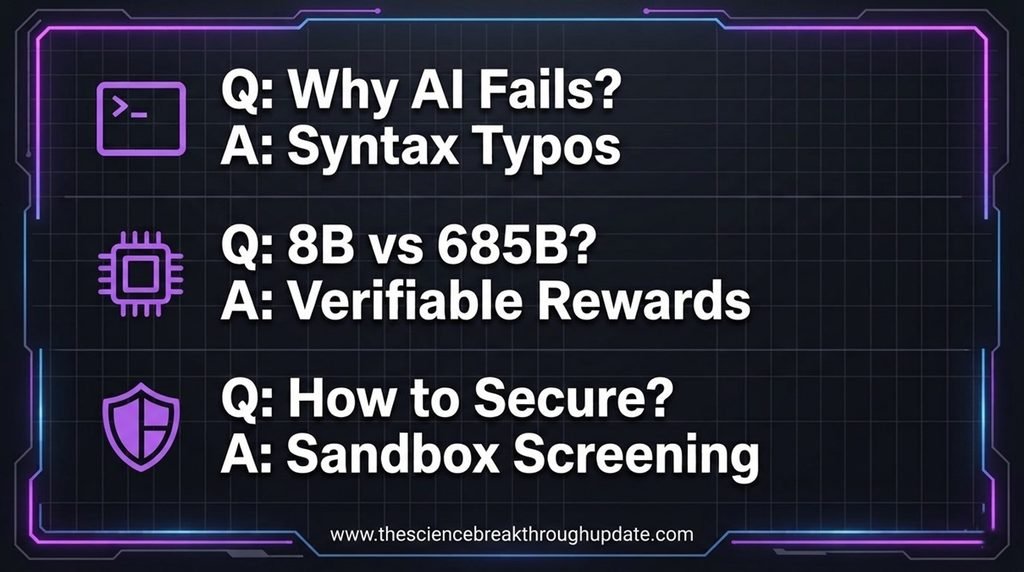
- Why does automated software struggle so much with basic command-line entries?
Terminal frameworks require absolute precision with symbols, spacing, and dashes. While humans easily catch tiny syntax typos, automated software frequently invents missing flags or mixes up long and short configuration aliases. - Can light network models perform as well as massive corporate computing clusters?
Yes, targeted training methods like reinforcement learning with verifiable rewards allow smaller systems to close the capability gap. A fine-tuned compact model can achieve operational results competitive with frameworks dozens of times its size. - Is it safe to let automated systems generate code for live networks?
Unsupervised automation remains risky because average open-weight exact accuracy in unrestricted settings hovers below 42%. Using multi-stage verification pipelines alongside sandboxed environments ensures bad scripts get caught before breaking critical enterprise infrastructure.
Source Document Link: arXiv.org
Share this useful knowledge with your friends now!”
Disclaimer: This content is based on preliminary scientific research (Preprints) from arXiv.org and current global findings. It is shared strictly for educational and informational purposes and does not constitute professional, legal. Readers are encouraged to verify facts independently and consult relevant experts before making any decisions.



