🌍 Scientists just found something unexpected hidden beneath our feet that completely rewrites our understanding of Earth’s deep interior structures.
Deep-Earth geophysics faces a massive puzzle regarding large low shear-velocity provinces sitting beneath Africa and the Pacific Ocean. For decades, laboratory measurements of a critical mantle mineral called davemaoite showed a baffling 30% lower shear modulus than standard theoretical physics equations predicted.
This massive gap left researchers questioning our entire model of the planetary interior. Now, a brilliant research team led by Peiyu Zhang and Liang Yuan has finally solved this decades-old mystery using advanced computer models. Their work reveals how tiny nanoscale grain-boundary disorders dramatically change how seismic waves travel through the deep mantle.
🌋 The Decades-Old Mystery Blocking Our View of Earth’s Core
- Direct samples from the lower mantle remain extremely rare because physical layers alter native mineral structures on their way to the surface.
- Laboratory settings struggle to measure davemaoite single crystals because the material undergoes structural transitions and amorphizes during decompression.
- Standard density functional theory calculations consistently overestimate the rigidity of this specific mineral matrix compared to laboratory press experiments.
- Traditional synchrotron x-ray diffraction methods remain completely blind to small fractions of amorphous or disordered structures within the crystal boundaries.
💻 How Million-Atom Simulations Cracked the Crystal Code
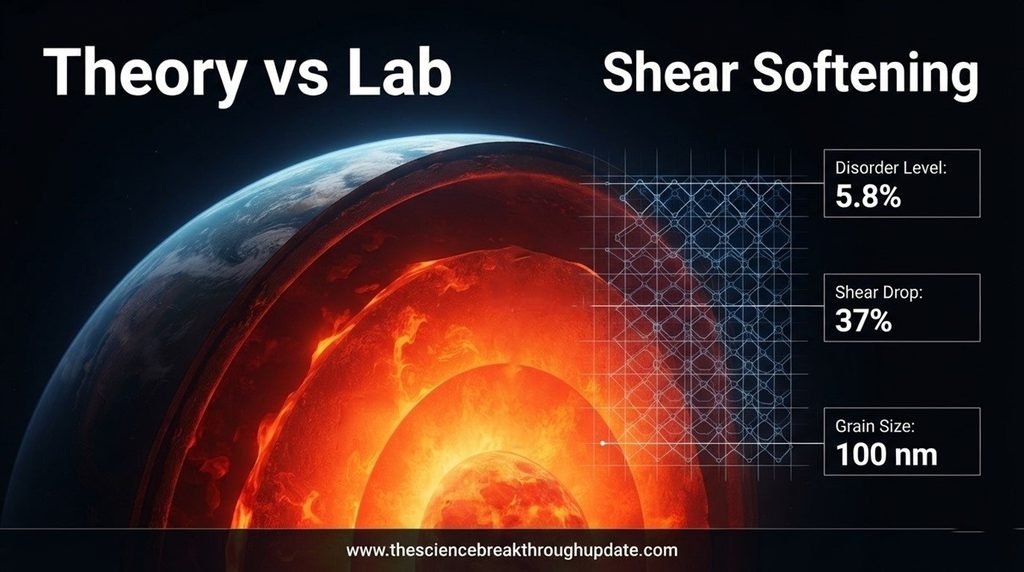
- The research team deployed million-atom machine-learning simulations to explicitly map out complex grain-boundary networks under realistic lower-mantle conditions.
- These intensive calculations proved that introducing just 5.8% disordered interfacial regions reduces the overall mineral shear resistance by a massive 37%.
- The atomic model tracks nonaffine displacements where local forces fail to cancel out properly, causing selective softening during massive seismic shear stresses.
- This precise softening behavior perfectly reconciles the data mismatch between pure textbook physics theory and messy real-world lab experiments.
💎 Redefining the True Size of Minerals Inside Our Planet
- By matching the new disorder-elasticity scaling equations with actual seismic observations, scientists calculated a minimum davemaoite grain size of 100 nanometers.
- This microstructural boundary confirms that the giant anomalies deep underground are composed of coarse-grained, long-lived mantle materials rather than fine dust.
- The discovery helps geophysicists model exactly how subducted basaltic crust reservoirs sink and cluster right above the core-mantle boundary zone.
- These insights provide a superior mineral physics framework for interpreting global 3D attenuation models built from whole-Earth oscillations.
My Take: Unlocking davemaoite’s grain boundaries proves we cannot model planets using perfect lab crystals. It’s a sharp reminder that nature’s messy details matter most when tracking deep geology.
❓ Reader Doubts: Core Questions Answered
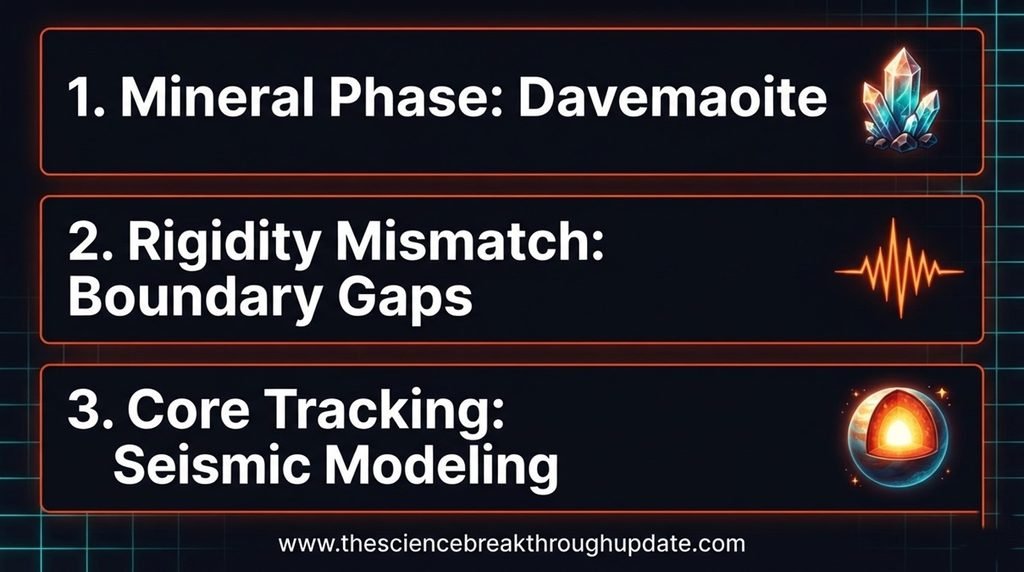
1. What exactly is davemaoite?
Davemaoite is a major calcium silicate mineral that forms under the intense pressure and temperature of Earth’s lower mantle. It makes up about 10% of pyrolite rock and up to 25% of subducted basalt.
2. Why did physics theory and laboratory experiments disagree?
Theoretical models assumed perfectly ordered single crystals, while laboratory samples always contained tiny, disordered boundary regions between mineral grains. These messy boundaries make the material much softer than pure equations suggest.
3. How do scientists know what is inside Earth if they cannot dig there?
Scientists track how seismic waves from earthquakes slow down, speed up, or lose energy as they pass through different planetary layers. They then replicate those exact conditions using supercomputer simulations and high-pressure laboratory presses.
Source Document Link: arXiv.org
Share this useful knowledge with your friends now!”
Disclaimer: This content is based on preliminary scientific research (Preprints) from arXiv.org and current global findings. It is shared strictly for educational and informational purposes and does not constitute professional, legal. Readers are encouraged to verify facts independently and consult relevant experts before making any decisions.